



Table of Contents
- Direct answer: inspect against an approved specification, not appearance alone
- Cosmetic packaging quality inspection checklist
- Visual quality, color, surface, and decoration
- Dimensions, weight, capacity, and component fit
- Function, assembly, dispensing, and leakage
- Format-specific checks for bottles, jars, tubes, and makeup packaging
- Bottles, jars, pumps, droppers, and sprays
- Tubes, palettes, mascara components, and powder containers
- Comparison table: defect categories and recommended checks
- AQL and sampling plans explained for packaging buyers
- Pre-shipment inspection versus incoming inspection in the United States
- How to define acceptance criteria with a supplier
- FAQ: cosmetic packaging quality inspections
- CTA: send your packaging specification and inspection requirements to YBJ Packaging
A practical cosmetic packaging quality inspection checklist for buyers reviewing bottles, jars, tubes, pumps, droppers, palettes, and other cosmetic containers before shipment and after receiving.
Direct answer: inspect against an approved specification, not appearance alone
Direct answer: A reliable cosmetic packaging inspection compares each lot with an approved drawing, component specification, reference sample, decoration standard, and agreed test method. Appearance matters, but dimensional accuracy, component fit, dispensing performance, leakage resistance, cleanliness, and shipping condition can determine whether the packaging is usable.
Acceptance limits should be agreed before production. Tolerance, sampling level, defect classification, leak-test method, and packaging configuration depend on the formula, filling process, quantity, tooling, decoration, destination, and approval sample.
Cosmetic packaging quality inspection checklist
Use this checklist as a starting point for a cosmetic container inspection. Convert each item into a measurable requirement where possible.
- Documents: Confirm the latest drawing, bill of materials, artwork, color reference, approved sample, packing specification, and purchase order.
- Visual condition: Check color, gloss, transparency, contamination, scratches, dents, deformation, flash, burrs, sink marks, weld lines, and other molding or finishing defects.
- Decoration: Verify artwork, logo position, text legibility, registration, color match, coverage, and adhesion when those requirements are specified.
- Dimensions and weight: Measure critical dimensions, component weight, wall or body features, capacity, neck finish, and closure fit using calibrated equipment and agreed tolerances.
- Function: Assemble production-intended parts and check opening, closing, actuation, priming, dosage, spray or drop behavior, wiper fit, hinge movement, and retention as applicable.
- Leakage and packing: Apply the agreed leak test, inspect inner and outer packaging, count units, verify carton marks, and record lot identification and sample results.
Visual quality, color, surface, and decoration

Packaging visual inspection should use consistent lighting, viewing distance, inspection time, and comparison samples. Separate appearance that affects brand presentation from defects that may affect assembly or product protection.
- Compare resin or glass color, opacity, transparency, gloss, and visible particles with the approved reference.
- Inspect the full surface for scratches, dents, black spots, bubbles, flow lines, deformation, flash, sink marks, and uneven seams.
- Check decoration for artwork accuracy, position, color, sharpness, missing areas, smearing, and damage after any agreed adhesion or rub check.
- Inspect contact and interior surfaces for visible contamination, loose particles, residue, or damage.
Color variation can be affected by material batch, molding conditions, lighting, and surface finish. Define the reference and acceptable limit instead of relying on an informal color judgment. For a deeper decoration review, see this guide to cosmetic packaging decoration techniques.
Dimensions, weight, capacity, and component fit

Dimensional checks confirm that packaging can run through filling, assembly, labeling, and packing operations. Measure critical features such as height, diameter, wall or shoulder dimensions, thread, snap features, closure height, and mating parts against the approved drawing.
A neck finish is the standardized opening profile and dimensions on a bottle that allow a pump, dropper, or cap to fit and seal. Check the neck finish together with the actual closure, not as an isolated bottle measurement. The relationship between nominal capacity, overflow capacity, fill line, and usable fill volume should also be documented.
Weight and capacity are not interchangeable. Resin, glass, decoration, tolerance, and production conditions can influence weight, while the filling line and formula determine the practical fill quantity. For neck dimensions and matching components, review this bottle neck finish guide.
Function, assembly, dispensing, and leakage
Functional inspection asks whether the complete pack performs as intended with production-equivalent components and, where appropriate, the intended formula. Assemble the bottle or jar, closure, pump, dip tube, actuator, overcap, insert, wiper, or other parts before testing.
- Check thread engagement, snap fit, torque or retention requirements, cap alignment, and ease of opening and closing.
- For pumps and sprays, check priming, actuation, return, dosage, and output pattern if these are included in the specification. Dosage means the approximate amount dispensed per complete actuation or cycle.
- For droppers, check insert fit, bulb recovery, drop formation, and the agreed delivery amount or range.
- For a cosmetic packaging leak test, define orientation, filled or empty condition, duration, temperature, pressure or movement, and pass criteria. The method depends on formula viscosity, closure design, headspace, filling process, and shipping conditions.
A leak test on an empty container may not represent performance with the actual formula. Compatibility and functional results should therefore be confirmed with representative samples before mass production.
Format-specific checks for bottles, jars, tubes, and makeup packaging
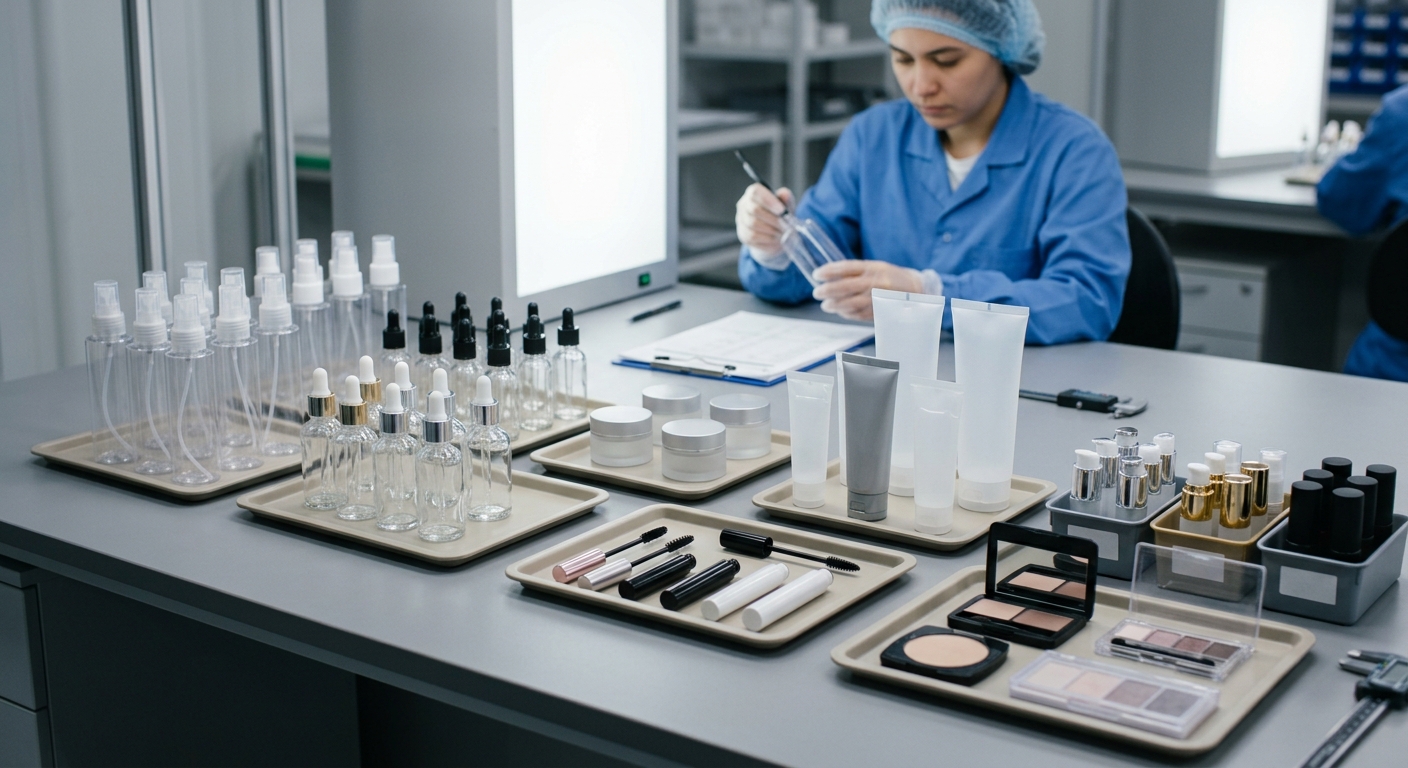
The core inspection categories apply across formats, but each package has failure points that deserve dedicated checks. The approved specification should identify which features are critical for the filling line and the finished consumer pack.
Bottles, jars, pumps, droppers, and sprays
- Bottles: Check body deformation, base stability, neck finish, wall appearance, internal cleanliness, and compatibility with the closure and filling equipment.
- Jars: Inspect the rim, liner or insert when included, thread or snap engagement, lid alignment, base stability, and the seal after closing.
- Pumps: Check dip-tube length, actuator movement, return, lock or unlock position, overcap fit, and specified dosage after priming.
- Droppers: Check pipette length, bulb or button recovery, insert seating, cap engagement, and drop delivery when defined.
- Sprays: Check actuator fit, lock feature, dip tube, priming, output, and cap retention according to the approved performance requirement.
Glass and plastic can show different cosmetic and dimensional characteristics, so the reference sample and tolerances should match the selected material and manufacturing process.
Tubes, palettes, mascara components, and powder containers
- Tubes: Inspect tube-body roundness, shoulder, seam, nozzle or orifice, cap hinge or thread, seal integrity, decoration, and squeeze or recovery behavior when required.
- Palettes: Check hinge movement, closure retention, pan fit, surface finish, magnet or clasp features when included, and protection of the product compartments.
- Mascara components: Check bottle neck, wiper seating, brush or applicator fit, cap engagement, excess-product control, and leakage during the agreed orientation test.
- Powder containers: Check sifter or insert fit, dispensing openings, lid retention, pan or well fit, and closure alignment.
For tube material selection, compare the inspection risks of PE and aluminum barrier laminate in this PE versus ABL cosmetic tube guide. Material choice can affect barrier behavior, appearance, flexibility, sealing, and decoration.
Comparison table: defect categories and recommended checks
Classify defects before inspection begins. The examples below are a practical framework; the buyer and supplier should approve the final definitions and limits for each project.
| Category | Examples | Recommended checks | Acceptance basis |
|---|---|---|---|
| Critical | Damage or contamination that could compromise safe handling or product protection | Review specification, production controls, and escalation procedure | Project-defined; may require additional inspection or a zero-acceptance rule |
| Major | Leakage, nonfunctional pump, wrong component, poor fit, severe deformation, or unusable decoration | Assembly, functional, dimensional, and leak testing | Agreed defect limit and sampling plan |
| Minor | Small cosmetic variation that does not affect function but is outside the visual standard | Controlled lighting and comparison with the approved sample | Defined size, location, quantity, or visibility limit |
| Logistics | Crushed cartons, missing separators, wrong count, mixed components, or incorrect marks | Carton, pallet, quantity, and labeling inspection | Purchase order and packing specification |
AQL and sampling plans explained for packaging buyers
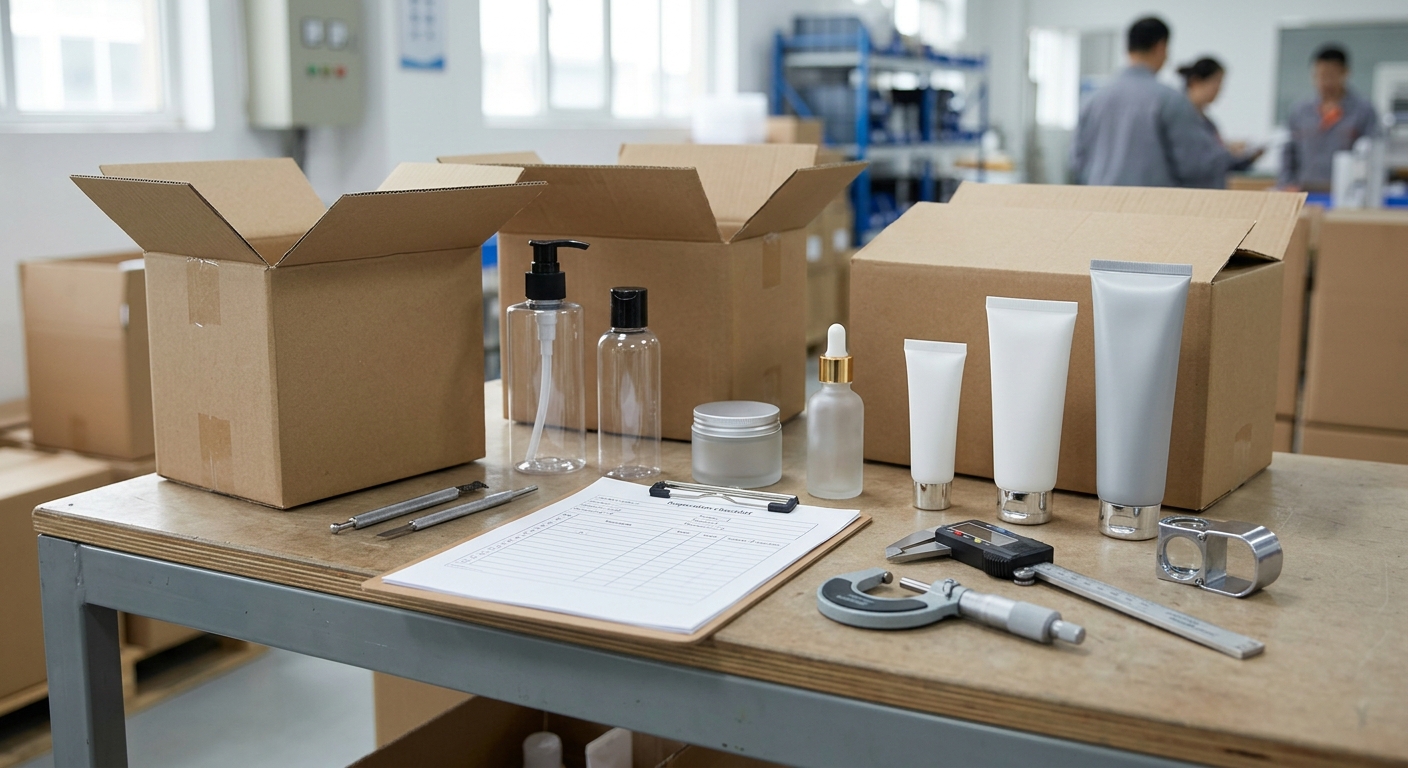
AQL, or Acceptable Quality Limit, is a sampling-plan reference used to decide how many units to inspect and how many observed defects may be accepted in a lot under the agreed plan. It is not a promise that every unit is defect-free, and it is not a substitute for defining the defect itself.
Before production, agree on the lot definition, sample size or sampling level, critical/major/minor classification, acceptance and rejection numbers, inspection conditions, and treatment of mixed or repeated defects. The plan should also explain whether functional checks, dimensional measurements, and leak tests are performed on the same sample or on separate samples.
Sampling should represent the lot by drawing units from different cartons or production portions where practical. Critical defects may require a stricter project-specific rule or additional inspection. The correct AQL cosmetic packaging plan depends on order quantity, risk, component complexity, and the consequences of failure.
Pre-shipment inspection versus incoming inspection in the United States
Pre-shipment inspection takes place at the supplier before the order is released. It can verify production quantity, workmanship, dimensions, assembly, function, leakage, cartons, and documentation against the approved specification. It is useful for identifying issues before international transport.
Incoming inspection takes place at the U.S. buyer, warehouse, or contract filler after receipt. It should confirm carton condition, quantities, lot identification, visible damage, component mix, and selected dimensional or functional characteristics. Transit damage, storage conditions, and handling after shipment can create issues that were not present at the supplier.
Use the same approved specification and reference sample at both stages, but do not assume one inspection replaces the other. Record carton numbers, photographs, sample quantities, defect descriptions, and disposition decisions. Any regulatory or filling-line requirements should be reviewed by the responsible buyer, filler, and technical or regulatory team.
How to define acceptance criteria with a supplier
Put the inspection requirements into the purchase specification rather than leaving them in email discussions. A practical development sequence is:
- Provide the product type, formula or viscosity context, capacity, dimensions, material, closure, pump, applicator, and filling application.
- Approve technical drawings, component samples, color references, artwork, decoration location, and packaging configuration.
- Identify critical dimensions and functions, then state the measurement method, equipment, sample condition, and tolerance.
- Define visual defect classes with photographs, limit samples, size or location limits, and lighting conditions.
- Agree on the sampling plan, lot definition, AQL or alternative acceptance method, leak-test protocol, and records required.
- Confirm how nonconforming units will be segregated, investigated, reworked, replaced, or approved by written deviation.
YBJ Packaging describes more than 20 years of cosmetic-packaging experience, a 10,000 m² intelligent facility, a Class 10,000 cleanroom, 12 automated assembly lines, and 23 Toshiba all-electric injection machines. A cleanroom is a controlled area where airborne particles are managed; it does not by itself establish that every finished unit meets a buyer’s specification. Confirm the applicable tooling, material, line, inspection records, compatibility work, MOQ, pricing, production timing, and shipping details for each project. Buyers can also review these common cosmetic packaging ordering mistakes before issuing a purchase specification.
FAQ: cosmetic packaging quality inspections
What is the most important inspection for cosmetic packaging?
There is no single universal check. Closure fit, leakage, dispensing function, cleanliness, and critical dimensions are often more consequential than minor appearance variation, but priority depends on the format, formula, filling line, and approved specification.
Can AQL replace a functional test?
No. AQL determines a sampling approach; it does not define pump dosage, leak-test conditions, dimensional tolerances, or component compatibility. Functional requirements need their own test method and pass criteria.
Should inspection use empty or filled packaging?
Use the condition specified for the test. Filled testing may be needed when viscosity, headspace, chemical contact, or closure interaction can affect performance. The formula and test setup should be agreed before production.
What should a buyer do if a shipment fails inspection?
Quarantine or identify the affected lot, document the defect and sample evidence, notify the supplier, and request a documented disposition. Rework, replacement, concession, or expanded inspection should be approved based on the defect and project requirements.
CTA: send your packaging specification and inspection requirements to YBJ Packaging
Send YBJ Packaging your current specification or early-stage concept for a project review. Include the product type, formula or viscosity context, capacity, dimensions, material, closure or pump, decoration, estimated quantity, filling application, destination, target date, inspection plan, and any required approval samples. YBJ can then review the appropriate packaging development, component fit, manufacturing, assembly, quality-check, and shipping requirements. Compatibility, MOQ, tooling, pricing, production time, and shipping depend on the project and approval status.
FAQ
What is the most important inspection for cosmetic packaging?
There is no single universal check. Closure fit, leakage, dispensing function, cleanliness, and critical dimensions are often more consequential than minor appearance variation, but priority depends on the format, formula, filling line, and approved specification.
Can AQL replace a functional test?
No. AQL determines a sampling approach; it does not define pump dosage, leak-test conditions, dimensional tolerances, or component compatibility. Functional requirements need their own test method and pass criteria.
Should inspection use empty or filled packaging?
Use the condition specified for the test. Filled testing may be needed when viscosity, headspace, chemical contact, or closure interaction can affect performance. The formula and test setup should be agreed before production.
What should a buyer do if a shipment fails inspection?
Quarantine or identify the affected lot, document the defect and sample evidence, notify the supplier, and request a documented disposition. Rework, replacement, concession, or expanded inspection should be approved based on the defect and project requirements.
Request a cosmetic packaging inspection and specification review
Share your packaging requirements with YBJ Packaging for a project-specific review. Please include the product type, formula or viscosity context, capacity, dimensions, material, closure or pump, decoration, estimated quantity, filling application, destination, target date, inspection requirements, and approval-sample needs. Compatibility, MOQ, tooling, pricing, production time, and shipping depend on the confirmed specification and project review.

 English
  Français
  Español