

Table des matières
- Direct answer: what is airless packaging?
- How an airless container works
- Airless packaging use-case table
- Formula, filling and compatibility limitations
- Customization and decoration options
- What to request in an airless sample
- FAQ
- Discuss an airless bottle project
Airless packaging uses a moving piston or collapsible chamber to dispense formula without drawing replacement air directly into the product reservoir. Understand the mechanism, realistic benefits and sample checks before specifying a system.
Direct answer: what is airless packaging?
Airless cosmetic packaging is a dispensing format that reduces the replacement air entering the product reservoir as formula is used. Instead of relying on a conventional dip tube in a vented bottle, it typically uses a rising piston or a collapsing inner pouch. The pump dispenses product while the reservoir becomes smaller.
Définition : An airless container separates the bulk formula from the air needed to balance pressure outside its moving piston or flexible chamber. “Airless” does not mean completely oxygen-free, sterile or impermeable.
For buyers seeking airless packaging explained in practical terms, the main benefit is controlled dispensing with less routine air exchange in the reservoir. It may also reduce finger contact compared with an open jar and improve product evacuation in a suitable design. None of these benefits establishes a formula’s shelf life or preservative requirements.
- What it can solve: a dispensing and product-access problem.
- What it cannot guarantee: formula stability, zero residue or a fixed dose with every formulation.
- What to confirm first: formula compatibility, pump output, filling method and approved filled-sample behavior.
YBJ Packaging’s Options de flacons sans air provide a starting category for discussion; confirm the mechanism and specifications of each proposed model.
How an airless container works
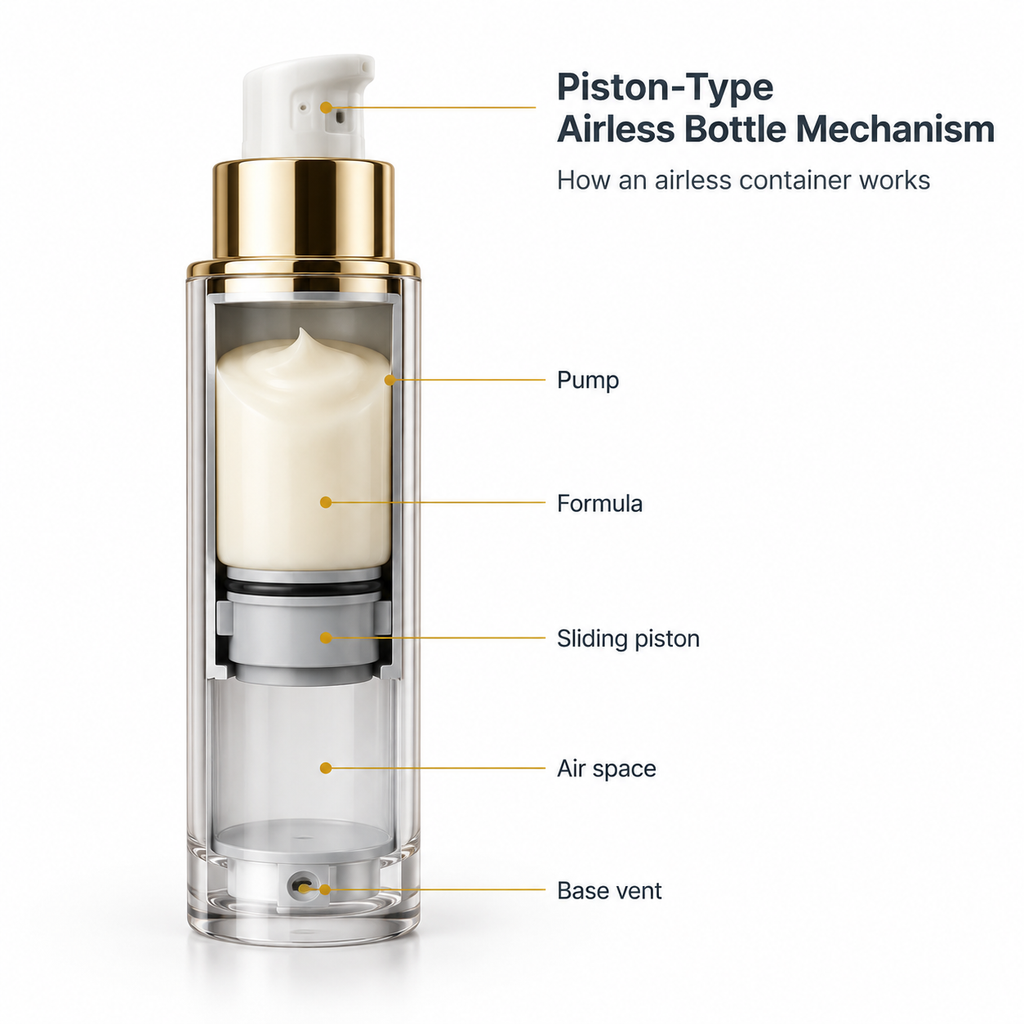
An airless pump bottle works by dispensing formula through a valve-controlled pump while a movable boundary follows the remaining product. In a common piston design, atmospheric pressure beneath the piston helps it rise as product leaves the chamber.
- The user presses the actuator, the part touched by the finger.
- The pump moves product through its outlet.
- On release, the pump refills from the reservoir through its inlet valve.
- The piston advances, reducing reservoir volume rather than admitting replacement air above the formula.
A base vent may admit air below the piston; this does not mean air is intentionally entering the formula chamber. Pouch-based systems achieve volume reduction differently, so request a component drawing rather than assuming every airless bottle uses a piston.
Pump and internal piston
The pump, piston, seals and bottle bore must function as a matched assembly. A piston that does not move smoothly, a poor seal or restricted flow can cause interrupted dispensing.
Ask which components contact the formula, whether any spring or metal component is in the product path, and how the actuator is protected during transport. A stock pump should not be substituted solely because its dimensions appear similar. The finition du col—the dimensions and attachment features at the container opening—must match, but fit alone does not establish dispensing compatibility.
Compare Options de pompes et de bouchons pour produits cosmétiques as complete assemblies, not interchangeable accessories.
Dosage and priming considerations
Posologie is the amount dispensed per full pump stroke; priming is the initial pumping needed to establish continuous output. Both must be checked with the intended formula, not inferred from an empty sample.
Entrapped air, viscosity, temperature and incomplete actuator strokes can affect output. Request the nominal output, its unit and the supplier’s test method. If the specification is volumetric but your filling team measures mass, account for formula density rather than treating milliliters and grams as equivalent.
Evaluate first-use priming, output after storage and dispensing near empty. Do not promise consumers a precise dose or operation in every orientation unless those conditions have been validated.
Airless packaging use-case table
Airless bottles are worth evaluating when controlled pump delivery and reduced reservoir air exchange matter. The right format depends on flow behavior, desired portion size and how the customer will use the product.
| Product context | Format to evaluate | Compatibilité potentielle | Main limitation to check |
|---|---|---|---|
| Flowable facial serum | Flacon à pompe sans air | Repeated dispensing without opening the reservoir | Low-viscosity sealing, output and restart behavior |
| Lotion or pumpable cream | Piston airless bottle | Portioned delivery and possible reduction in remaining residue | Formula feed into pump and piston travel |
| Very thick paste or particle-containing formula | Specialized airless system, tube or jar | Alternative formats may accommodate application needs | Valve restriction, clogging and incomplete evacuation |
| Larger-volume body lotion | Conventional lotion pump bottle or airless system | Conventional pumps may suit familiar filling and use patterns | Compare air exchange, package dimensions, output and assembly requirements |
These are screening directions, not confirmed product recommendations. For a squeeze-dispensing alternative, review soft plastic tube packaging with the same formula and filling brief.
Formula, filling and compatibility limitations
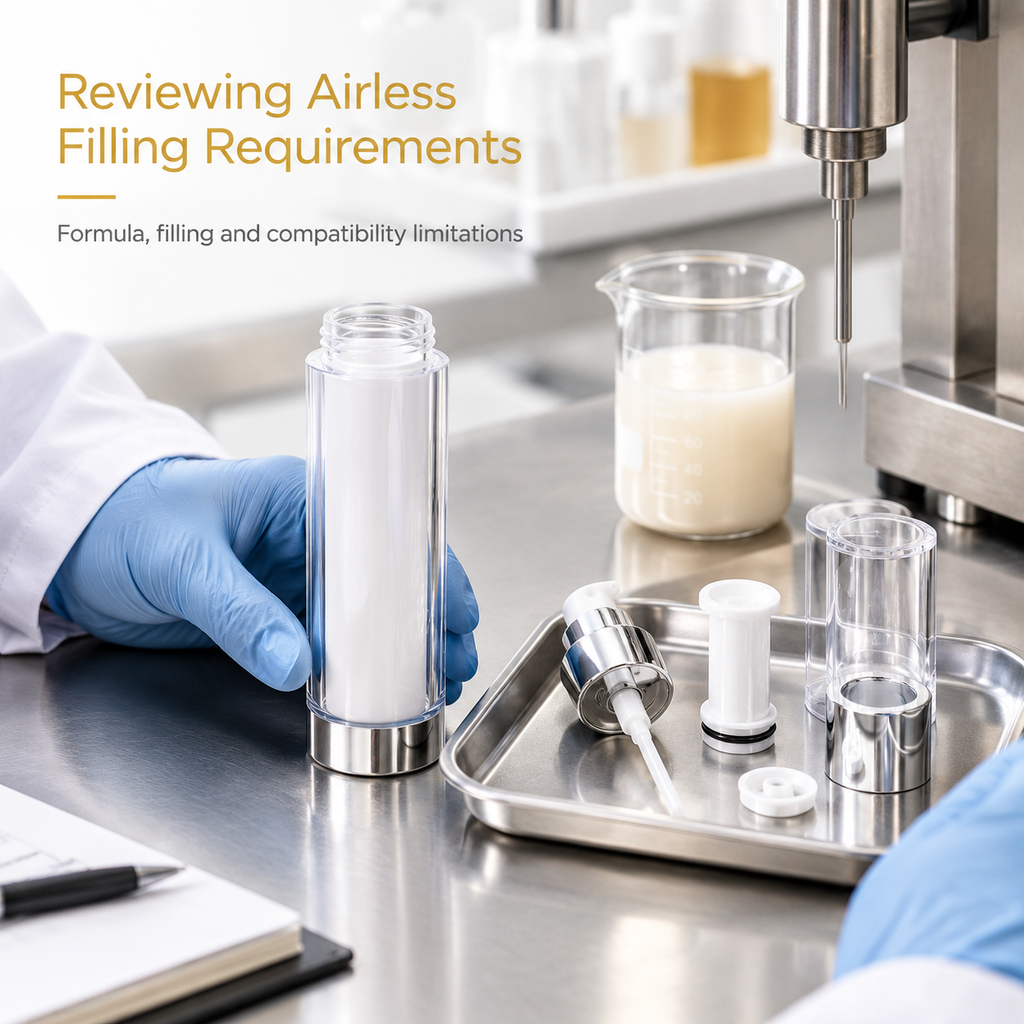
Before choosing an airless bottle, confirm chemical compatibility, dispensing performance and filling-line suitability as separate requirements. Passing one does not establish the others.
- Formula contact: assess the reservoir, piston, valves and seals for swelling, cracking, discoloration, odor changes or other interactions under an agreed protocol.
- Flow behavior: viscosity alone is insufficient. Stringiness, particles, entrapped air and temperature-dependent thickening can affect pump refill.
- Barrier limitations: oxygen can remain in the formula or headspace and can permeate through materials. Airless packaging does not automatically justify preservative reduction or shelf-life extension.
- Filling: confirm fill direction, nozzle access, piston starting position, required headspace, closure assembly and whether the process traps air. Do not assume suitability for hot filling.
- Distribution: evaluate leakage, actuator protection and dispensing after relevant temperature, pressure and handling exposures.
Use the intended commercial formula and agree on acceptance criteria with the formulator, filler and packaging supplier. Any stability or cosmetic safety assessment remains a separate responsibility from confirming package function.
Customization and decoration options
Customize appearance only after confirming the functional assembly. Body shape, outer shell, color, actuator and decoration can change tooling, assembly access and inspection requirements.
Request separate material specifications for the outer shell and product-contact reservoir. PETG, a glycol-modified polyester, and AS, a styrene-acrylonitrile plastic, may be discussed for rigid appearance components where the design permits; neither name proves suitability for direct formula contact. Confirm actual material availability for the selected model.
Ask about molded color, printing, hot stamping, coatings or metallized finishes rather than assuming every process is available on every substrate. Check adhesion, abrasion, formula-spill resistance and whether decoration affects seams, vents or actuator movement.
Multi-component construction and decorative layers can complicate sorting and recycling. Do not describe an airless container as recyclable or refillable without assessing its actual construction and the destination’s collection arrangements.
What to request in an airless sample
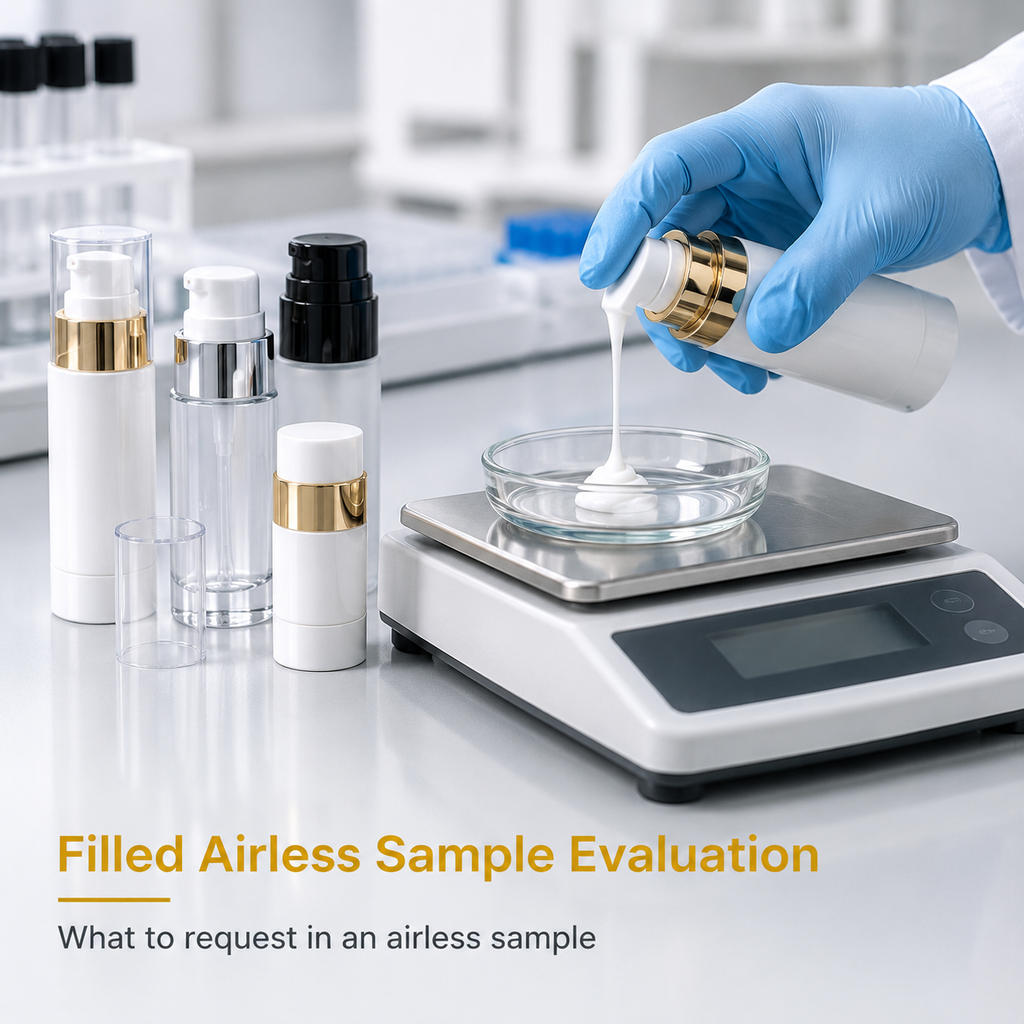
Request a production-representative assembly with a written specification, then evaluate it filled. An attractive empty sample cannot demonstrate compatibility, priming or evacuation.
- Identify the assembly: request model references, capacity, dimensions, material breakdown, component drawing, closure attachment and nominal pump output.
- Document filling: record formula batch, fill weight, process temperature, equipment, piston setup and closure procedure.
- Check dispensing: record priming strokes, full-stroke output, restart behavior, piston movement and usable product remaining at the agreed endpoint.
- Evaluate storage and transport: agree on conditions, duration, orientation, leakage criteria and post-exposure operation.
- Approve decoration and assembly: retain signed reference samples and document approved changes before production.
Ask the supplier to distinguish stock evaluation samples from pilot or production-equivalent samples. Formula compatibility, MOQ, tooling, pricing, production time and shipping depend on project details and approval; sample availability alone does not settle these terms.
FAQ
Airless describes the dispensing architecture, not a guarantee of formula protection or universal usability. These common questions should be resolved against the selected assembly.
Is an airless bottle completely airtight?
No. It limits replacement air entering the reservoir during dispensing, but residual air, material permeability and seal performance still matter.
Can every cream use an airless pump system?
No. The formula must feed through the inlet and valves reliably. Very thick, stringy or particle-containing products need specific filled-sample testing.
Does airless packaging need preservatives?
Airless construction alone does not establish preservation requirements. The qualified formula team must assess the finished product and intended use.
Can customers refill an airless bottle?
Only if the system is designed and validated for refilling. Opening a single-use assembly may damage seals or prevent correct piston resetting.
Will an airless bottle dispense all the product?
Not necessarily. Residue depends on formula behavior, internal geometry, pump design and the test endpoint. Request evacuation results for your filled sample rather than assuming zero waste.
Discuss an airless bottle project
A successful airless project starts with matching the formula, pump and filling process—not simply selecting a bottle silhouette. Treat controlled dispensing and reduced air exchange as design objectives to verify through samples.
Company-stated capabilities: YBJ Packaging describes more than 20 years of cosmetic-packaging experience, a 10,000 m² intelligent facility, a Class 10,000 cleanroom, 12 automated assembly lines and 23 Toshiba all-electric injection machines. A cleanroom is an environment with controlled airborne particles; it does not mean the finished package is sterile. Confirm the applicable production environment, equipment and inspection scope for your project.
YBJ offers OEM and ODM support spanning consultation, design, mold development, material selection, manufacturing, assembly, quality checks and worldwide shipping. The practical next step is a complete brief and an agreed sample-validation plan.
FAQ
Is an airless bottle completely airtight?
No. It limits replacement air entering the reservoir during dispensing, but residual air, material permeability and seal performance still matter.
Can every cream use an airless pump system?
No. The formula must feed through the inlet and valves reliably. Very thick, stringy or particle-containing products need specific filled-sample testing.
Does airless packaging need preservatives?
Airless construction alone does not establish preservation requirements. The qualified formula team must assess the finished product and intended use.
Can customers refill an airless bottle?
Only if the system is designed and validated for refilling. Opening a single-use assembly may damage seals or prevent correct piston resetting.
Will an airless bottle dispense all the product?
Not necessarily. Residue depends on formula behavior, internal geometry, pump design and the test endpoint. Request evacuation results for your filled sample rather than assuming zero waste.
Discutez de vos emballages cosmétiques sur mesure
Tell YBJ Packaging your product type, formula or viscosity context, package format, capacity, dimensions, preferred material, closure or pump, decoration, estimated quantity, filling application, destination and target date. The team can review your brief and suggest practical OEM or ODM options. Include any sample or compatibility-testing needs; specifications, pricing and delivery require project review and approval.

 English
 Français
 Español
