



Table of Contents
- Which closure suits the shampoo and use setting?
- Pump versus cap comparison table
- Neck finish, dip tube and dispensing terms
- Review a YBJ PET shampoo bottle example
- Steps to approve the bottle-and-closure assembly
- Checks for filling, leakage and shipping
- Inquiry checklist and FAQs
Choose a PET shampoo bottle and dispensing closure by considering formula viscosity, use setting, neck finish, dosage, filling-line requirements and shipping conditions. A pump often improves one-handed dispensing, while a flip-top or disc-top cap can simplify packing and evacuation.
Which closure suits the shampoo and use setting?
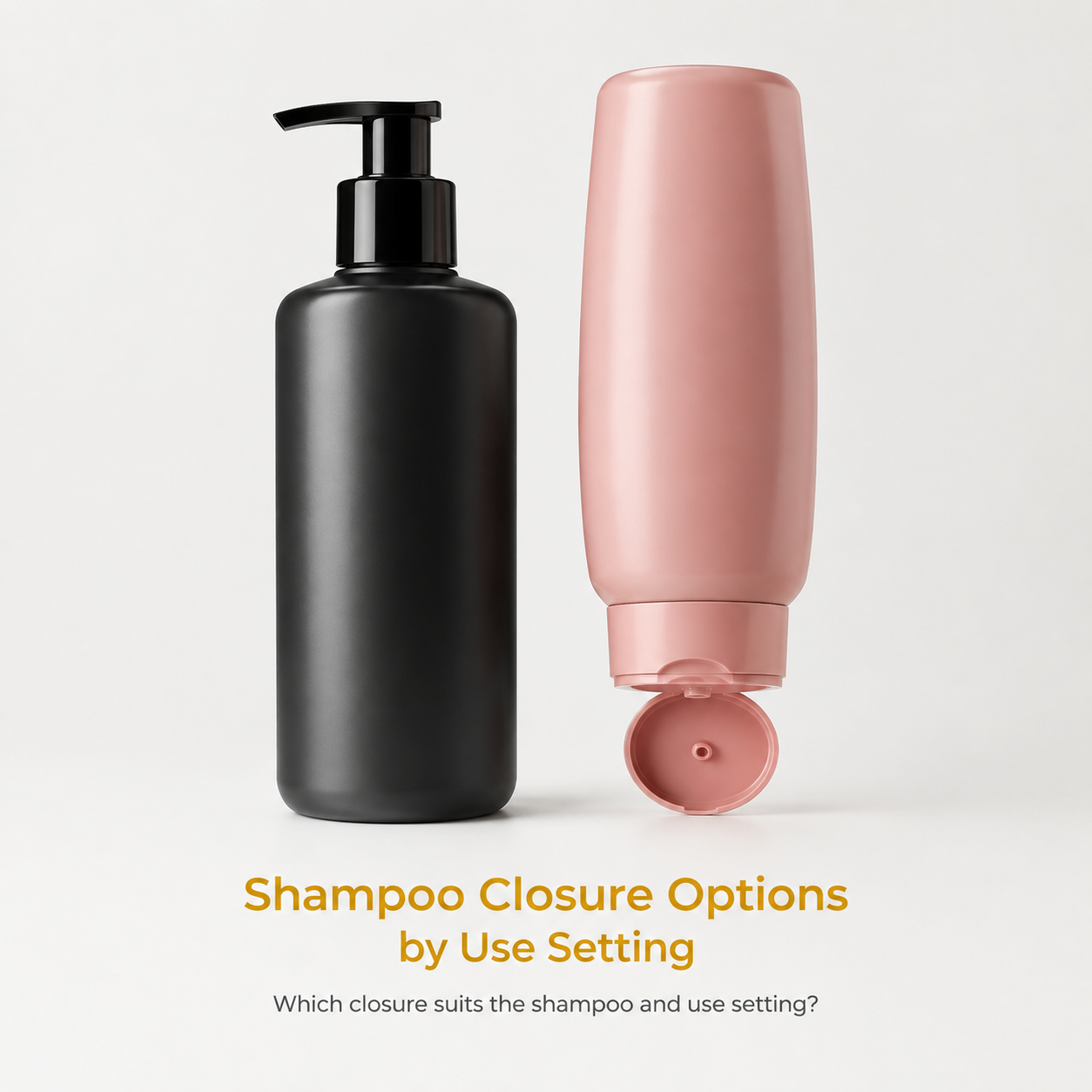
A pump is generally preferable when the shampoo will remain upright and users value controlled, one-handed dispensing. A flip-top or disc-top cap may be more suitable for shower use, travel, refill applications or packages designed to be inverted and squeezed.
The decision should begin with the complete use case, not appearance alone. Consider whether the bottle will sit on a shower shelf, salon station, hotel counter or retail shelf. Also review viscosity, intended dose, wet-hand handling, expected evacuation and whether the package must be locked for distribution.
Key takeaways
- Choose the closure around use: pumps support repeatable one-handed operation; caps provide a simpler flow path and can suit thicker products.
- Specify the complete assembly: a pictured pump should not be assumed to fit another bottle, even when both components look similar.
- Approve with the actual formula: viscosity, suspended ingredients and temperature can affect priming, flow and residue around the outlet.
- Test filled samples: final performance depends on the bottle, neck, closure, liner or seal, dip tube, filling process and shipping conditions together.
PET, or polyethylene terephthalate, is a clear thermoplastic commonly selected for personal-care bottles because it can provide good visual clarity, colorability and a useful balance of rigidity and weight. Actual formula compatibility, wall construction and filling-temperature suitability remain project dependent and should be evaluated before production.
Pump versus cap comparison table
Neither closure is universally better. A lotion pump favors controlled upright dispensing, while a flip-top cap favors a direct flow path, compact shipping profile and squeeze-assisted use.
| Decision factor | Lotion pump | Flip-top or disc-top cap |
|---|---|---|
| Typical use | Countertop, salon or family-size bottle used upright | Shower, travel or squeezable bottle used upright or inverted |
| Dispensing action | Press actuator after priming | Open cap and squeeze or pour |
| Output control | Nominal dosage can be specified, but actual delivered output must be checked with the formula | Output depends strongly on orifice size, squeeze force, viscosity and bottle flexibility |
| Thicker shampoo | Requires a pump engine and flow path suitable for the viscosity | A sufficiently sized orifice may provide a simpler route for thick formulas |
| Evacuation | Depends on dip-tube position, bottle geometry and pump performance | Inverted use can help move product toward the opening |
| Transit preparation | May need a lock, clip or protective packing method | Needs secure closure engagement and may use an induction seal or liner where compatible |
| Assembly considerations | Dip-tube length, closure torque and actuator orientation matter | Hinge orientation, orifice, seal system and application torque matter |
| User trade-off | Convenient operation but more components | Compact and straightforward but less metered dispensing |
A pump’s stated dosage is its nominal output per full stroke under defined conditions. It is not a guarantee of the amount a consumer will receive with every formula or partial press. Request filled-sample trials when dose consistency is commercially important.
Neck finish, dip tube and dispensing terms
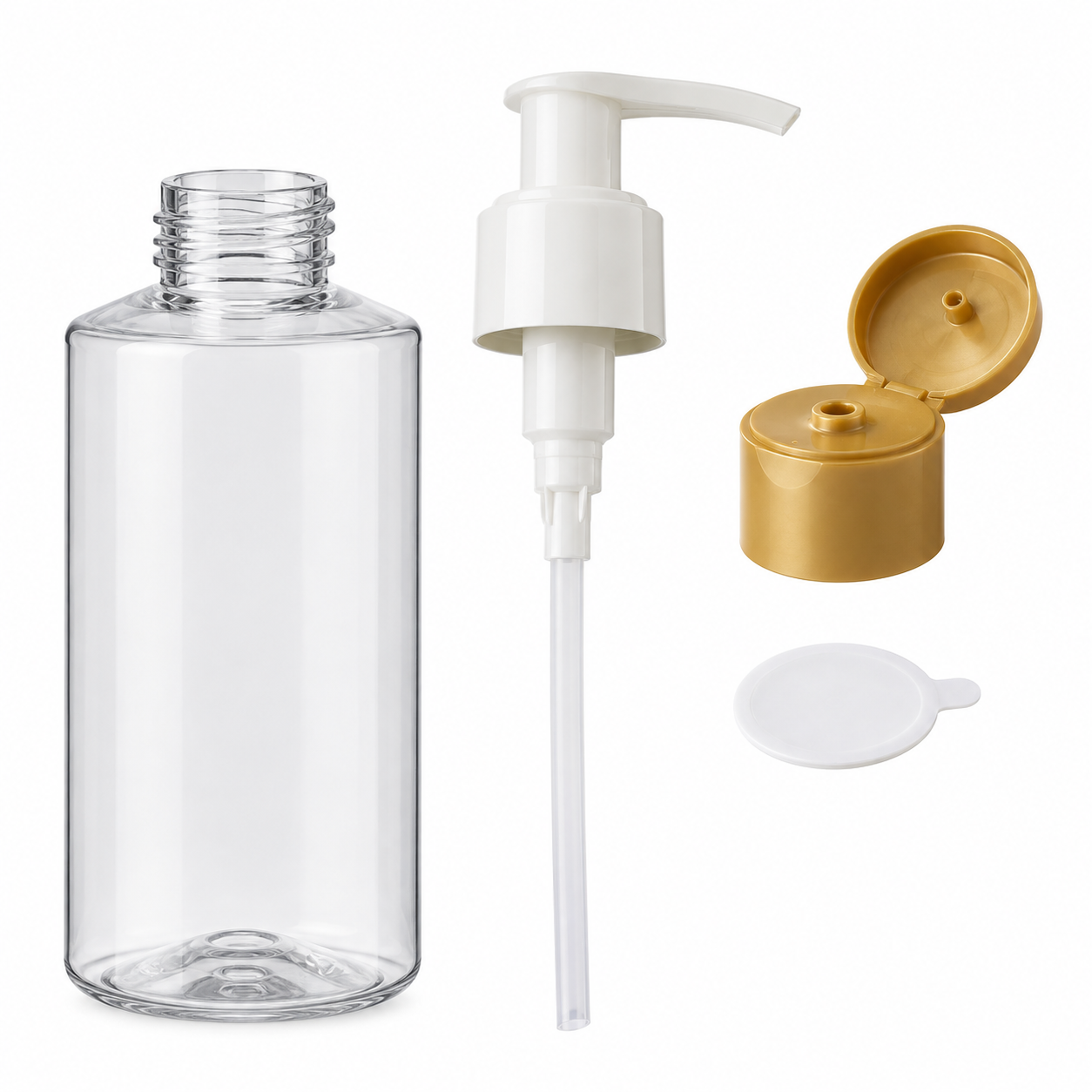
Neck finish means the standardized or custom dimensions and thread details at the bottle opening that connect the bottle to its closure. Matching only the nominal neck size is insufficient; the thread profile, sealing surface, neck height and closure design must work together.
- Bottle neck finish
- The opening diameter and mechanical features used to attach and seal a cap or pump. The supplier should confirm the bottle drawing and compatible closure specification.
- Dip tube
- The tube that carries shampoo from inside the bottle into a pump. Its material, inside diameter, angle and cut length influence flow and product evacuation.
- Dosage
- The pump supplier’s nominal amount delivered by a complete stroke under specified test conditions. Formula viscosity and user action may change actual output.
- Closure torque
- The rotational force used to apply a threaded closure. Too little may reduce sealing reliability; too much can damage threads, distort sealing surfaces or make removal difficult.
- Priming
- The initial strokes required to draw product through the dip tube and pump before regular dispensing begins.
Can a buyer assume a pictured pump fits the selected bottle? No. Product photography shows a configuration, not universal component compatibility. Confirm the exact neck drawing, pump or cap code, seal system, dip-tube specification and approved assembly sample with YBJ Packaging.
Review a YBJ PET shampoo bottle example
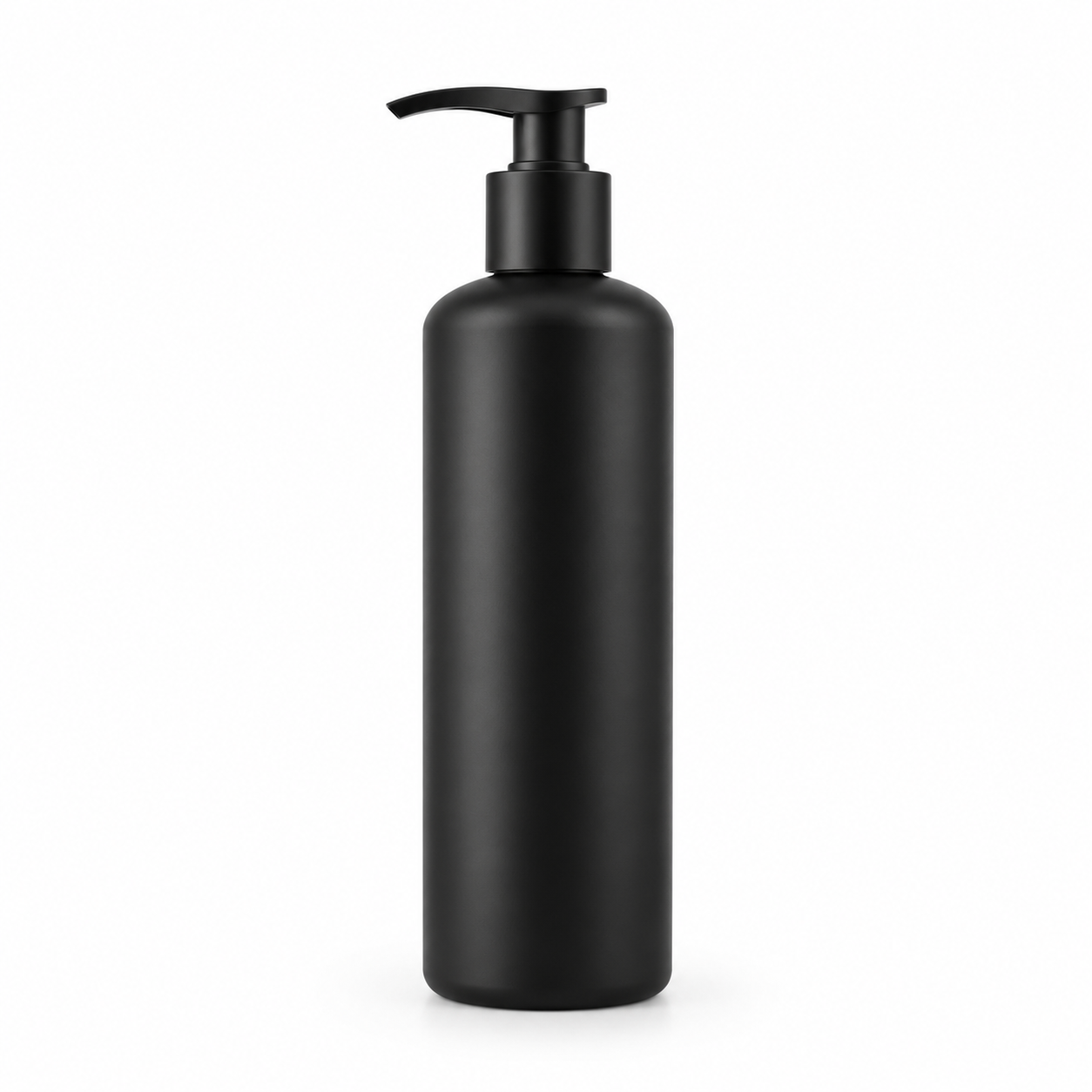
YBJ’s product listings can be used as visual and format references, but the exact capacity, dimensions, neck finish, pump output, color, finish and decoration available for an order should be confirmed from the current project specification.
| YBJ reference | Useful sourcing reference | What to confirm |
|---|---|---|
| black full-frosted PET shampoo bottle | Dark monochrome appearance with a pump-format presentation | PET grade, capacity, bottle dimensions, neck finish, pump compatibility, surface finish and decoration adhesion |
| pink PET shampoo bottle reference | Shaped shampoo bottle shown in several sizes with dispensing components | Available sizes, exact closure options, color matching, label or print area and filled-package stability |
| amber PET lotion bottle reference | Shows how colored PET can support a different visual direction in a pump package | Suitability for the intended shampoo capacity, neck and pump combination; do not assume the pictured configuration transfers to a shampoo bottle |
These references help communicate shape, color and merchandising direction. They do not establish that every shown pump, cap or finish is interchangeable. For a PET shampoo bottle with pump or cap, request a bill of materials covering the bottle, closure, actuator, dip tube, gasket or liner, overcap or lock where applicable, and any transit seal.
YBJ Packaging capabilities stated on its website
YBJ Packaging describes more than 20 years of cosmetic-packaging experience, a 10,000 m² intelligent facility, a Class 10,000 cleanroom, 12 automated assembly lines and 23 Toshiba all-electric injection machines. A cleanroom is a controlled production environment designed to limit airborne particles. Buyers should confirm which facility, process, cleanliness controls and inspection plan apply to their specific project.
Steps to approve the bottle-and-closure assembly

Approve the bottle and closure as one filled system through a documented sequence: define the use case, lock component specifications, test samples with the formula, trial the filling process and retain an approved reference.
- Define the product and use setting. State the shampoo type, viscosity range or representative sample, capacity, upright or inverted use, target dose and sales channel.
- Select the bottle format. Confirm material, nominal capacity, overflow capacity, dimensions, weight, color, finish and decoration area. Ask whether the filling temperature or process introduces any PET-specific constraints.
- Match the closure. Confirm the exact bottle neck finish against the pump or cap drawing. For a pump, define nominal dosage, lock type, actuator, dip-tube material and cut length. For a cap, define orifice, hinge style, liner or seal and intended orientation.
- Review decoration. Evaluate screen printing, labeling, color coating or other requested finishes on the selected bottle surface. Approval depends on artwork, substrate, treatment and production process.
- Build representative samples. Use production-intent bottle and closure components where possible. Fill them with the actual formula or an agreed representative material.
- Run functional and line trials. Check capping, torque control, fill accuracy, conveyor handling, pump orientation, label application and packing operations on the intended equipment.
- Approve and retain standards. Sign off drawings, colors, decoration, function and pack-out. Keep approved samples or documented standards for production comparison.
Tooling, MOQ, pricing, sample scope and production time depend on the selected mold, components, decoration, quantity and approval requirements. They should be reviewed after YBJ receives the project brief.
Checks for filling, leakage and shipping
A filled assembly should be checked for leakage in its intended upright, side and inverted orientations, including after realistic temperature and transport conditioning. The protocol must reflect the formula, seal design, closure application and distribution route.
Start by confirming the specified fill volume and headspace. Apply closures using a controlled method and record application torque or the relevant assembly setting. Inspect the neck, thread and sealing surface for product contamination because shampoo trapped in this area can interfere with sealing.
- Observe samples upright, on their sides and inverted for a defined period.
- Check around the neck, pump collar, actuator and cap orifice for seepage or residue.
- Cycle pumps to assess priming, nominal output, recovery, clogging and dripping.
- Open and close caps repeatedly to review hinge behavior, snap engagement and wet-hand use.
- Condition samples at project-relevant temperatures, then return them to room conditions and inspect for distortion, loosening or leakage.
- Pack samples in the proposed carton configuration and perform an agreed shipping simulation or distribution trial.
- Repeat critical checks after conditioning because a package that is initially dry may leak after vibration, impact or temperature change.
The appropriate sample count, duration, temperature range, drop method and acceptance criteria should be set by the buyer and supplier for the destination and channel. Testing supports an approval decision but does not justify a universal leakage guarantee.
Inquiry checklist and FAQs
A useful closure inquiry specifies the product context, bottle requirements and dispensing target as one complete brief. This lets the supplier evaluate component matching instead of quoting a bottle and closure independently.
- Product type and formula or viscosity context, including suspended particles if applicable
- Nominal capacity, preferred dimensions and required fill volume
- PET material, color, transparency, surface finish and bottle shape preferences
- Preferred pump, flip-top cap or alternative closure
- Required neck finish, if already fixed, or a request for a matched recommendation
- Target pump dosage or cap orifice and intended upright or inverted use
- Dip-tube requirements, sealing method, lock or transit-security needs
- Decoration artwork, print method, label area and color references
- Estimated order quantity and whether a stock format or custom mold is being considered
- Filling application, equipment, filling temperature and capping method
- Destination market, shipping method and proposed carton configuration
- Target approval and launch dates
Include an actual formula sample or agreed substitute when compatibility and dispensing trials are required. YBJ can review OEM or ODM options, but compatibility, MOQ, tooling, pricing, production time and shipping remain dependent on project details and approved samples.
Conclusion: The right shampoo package is a verified assembly, not simply a PET bottle paired with a visually suitable closure. Select the format around the use setting, confirm the neck and component drawings, and approve filled samples through dispensing, filling, leakage and distribution checks.
FAQ
When is a pump preferable to a cap for shampoo packaging?
A pump is often preferable for an upright bottle used repeatedly on a counter, salon station or shower shelf, especially when one-handed dispensing and a defined nominal output are priorities. Confirm that the pump engine and dip tube can handle the shampoo’s viscosity and that the actuator can be secured for shipping.
What does bottle neck finish mean?
Bottle neck finish describes the dimensions, threads and sealing features at the bottle opening that connect with a closure. A nominal diameter alone does not prove compatibility. The bottle and closure drawings, thread profile, sealing surface and approved assembly sample should agree.
Can I assume the pump shown in a product photo fits my selected PET bottle?
No. A product photo represents a displayed configuration, not a universal fit claim. Ask YBJ Packaging to confirm the bottle code, neck finish, pump or cap code, dip-tube specification, sealing system and assembled sample for the project.
How should a filled PET shampoo bottle be checked for leakage?
Apply the closure under controlled conditions and inspect filled samples upright, on their sides and inverted. Repeat inspection after relevant temperature conditioning and packed transport simulation. The formula, fill level, closure torque, seal design, test duration and acceptance criteria should be documented.
What should a shampoo bottle closure inquiry specify?
Specify the formula and viscosity context, capacity, bottle dimensions, PET color and finish, neck finish, closure type, target pump dosage or cap orifice, dip tube, seal, decoration, estimated quantity, filling process, destination and target date. Also state whether you need stock packaging, custom decoration or mold development.
Discuss Your Custom Cosmetic Packaging
Tell YBJ Packaging what you are filling, the package format and capacity you need, your material and decoration preferences, estimated quantity, destination and target date. Include the formula or viscosity context, preferred bottle dimensions, closure or pump, filling application and any target dosage. The team can review the brief, discuss samples or compatibility checks, and suggest practical OEM or ODM packaging options for your project. Compatibility, tooling, MOQ, pricing, production time and delivery can be confirmed only after the project requirements and approval process are reviewed.

 English
 Français
 Español
