

Índice
- Which bottle appearance fits the product brief?
- PET lotion bottle appearance comparison table
- Visibility, decoration and finish approval
- Review YBJ's listed bottle examples
- Steps to approve color and decoration samples
- When formula or light-exposure checks are needed
- Lista de comprobación para consultas y preguntas frecuentes
- Comenta tu envase cosmético personalizado
Compare clear, matte white, black, blue and amber PET lotion bottle appearances, including visibility, decoration, component matching and the samples buyers should approve before production.
Which bottle appearance fits the product brief?
The best choice among PET lotion bottle color options depends first on the desired shelf appearance, product visibility and decoration plan. Clear PET exposes the formula and fill level, matte white creates a soft opaque-looking presentation, and black, blue or amber colors can support brand differentiation. Color alone, however, should not be treated as proof of formula protection.
Key takeaways: Choose the visual direction with the formula color, label artwork, pump and retail environment in mind. Approve the bottle, decoration and closure together under representative lighting. If light exposure could affect the formula, request a project-specific compatibility and light-exposure assessment rather than relying on the color name.
Definition: PET, or polyethylene terephthalate, is a plastic commonly used for personal-care bottles. It can provide good clarity and design flexibility, but its suitability depends on the formula, bottle construction, filling process and intended use. A acabado del cuello is the standardized or custom geometry at the bottle opening that connects to a pump or cap. Posología is the amount a dispensing pump delivers per actuation.
A clear PET lotion bottle is useful when the visible product is part of the merchandising concept or when users need to see the remaining fill. Before choosing it, check whether the formula changes color, separates, leaves visible residue or requires protection from light. Matte white and darker colors hide more of the formula, but the degree of opacity must be confirmed on a physical sample.
PET lotion bottle appearance comparison table
Clear, matte white and colored PET bottles differ most directly in product visibility, artwork contrast and the way small color variations appear. The table below is a sourcing comparison, not a guarantee of opacity, UV resistance, compatibility or decoration performance.
| Appearance | Typical visual fit | Points to verify | Potential limitation |
|---|---|---|---|
| Borrar | Formula-led presentation, visible fill level and a clean visual style | Formula appearance, resin clarity, color consistency, scuff visibility and decoration contrast | Residue, separation, bubbles or fill variation may be visible |
| Matte white | Soft-touch visual effect, restrained skincare positioning and strong contrast for dark artwork | Matte process, gloss level, opacity, fingerprinting, rub resistance and lot-to-lot color tolerance | Fine artwork or pale printing may lose contrast without a physical proof |
| Black | High-contrast, premium or unisex presentation | Black standard, surface gloss, dust visibility, decoration adhesion and pump color match | Dark surfaces can make dust, scratches or handling marks more noticeable |
| Blue | Distinctive color coding for a product family or brand identity | Target shade, transparency, wall-thickness effects, pump match and printed-color contrast | The same color specification can appear different under retail and studio lighting |
| Ámbar | Apothecary-inspired appearance or warm color coding | Amber shade, transparency, formula interaction and measured light-transmission requirements | An amber appearance does not by itself establish adequate light protection |
For any option, ask whether the color is produced in the resin, applied as a coating or created through another finishing process. That choice can affect appearance, decoration sequence, testing needs, cost and production conditions. Exact feasibility depends on the bottle design, quantity and approved sample.
Visibility, decoration and finish approval
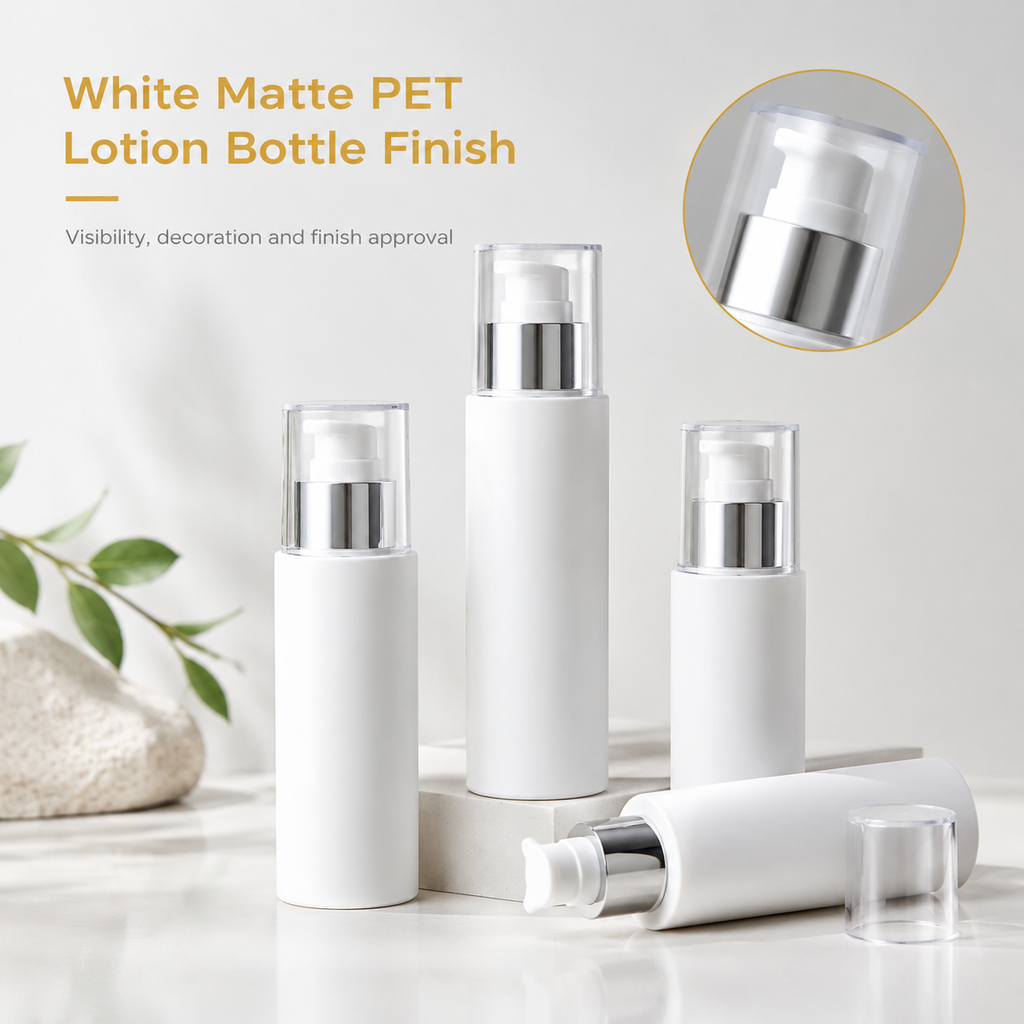
A buyer should approve a matte finish by reviewing a physical sample that represents the intended substrate, color and decoration process. A digital rendering can establish direction, but it cannot reliably communicate gloss level, tactile feel, opacity, print registration or how the surface responds to handling.
Inspect matte samples under consistent daylight-equivalent and retail lighting. Compare them with a signed color reference, then evaluate fingerprints, scuffs, artwork edges and the transition between the bottle and closure. For screen printing, hot stamping, labeling or coating, approve the actual decoration on the intended bottle whenever possible. Curvature, surface energy and finish texture can change line sharpness and adhesion.
Color references should be specific. Send a physical master sample or a recognized color reference, artwork files with spot colors identified, the required gloss or matte direction, and photographs showing the intended assembled appearance. State which reference controls if a screen image, printed chip and physical bottle do not match.
Review YBJ's listed bottle examples
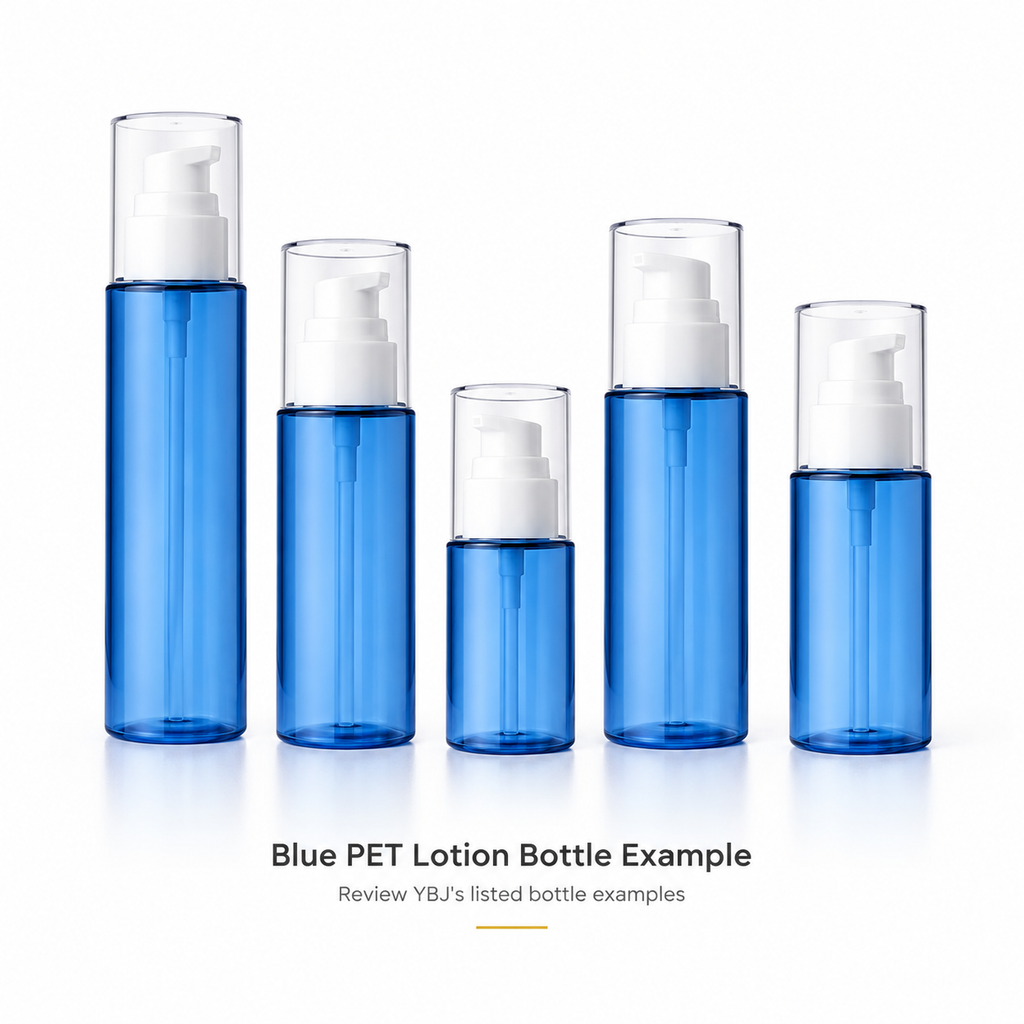
YBJ Packaging lists PET lotion bottle examples in different visual directions, including matte white and blue. These listings are useful starting references, but buyers should confirm capacity, dimensions, neck finish, material construction, color process, pump compatibility and availability for the specific project.
| Listed example | What it helps a buyer review | Project details to confirm |
|---|---|---|
| Frascos de loción PET blanco mate | Matte appearance, white color direction and coordination with metallic or neutral pump components | Capacity, opacity, finish method, decoration area and closure specification |
| frascos de loción PET azules | Colored PET presentation and comparison of bottle color with a white dispensing component | Target blue reference, transparency, dimensions, pump output and artwork contrast |
| PET lotion bottle examples with pumps | General bottle proportions and white or black pump combinations | Intended reuse claim, formula compatibility, neck fit, dosage, locking method and filling-line needs |
YBJ Packaging states on its website that it has more than 20 years of cosmetic-packaging experience, a 10,000 m² intelligent facility, a Class 10,000 cleanroom, 12 automated assembly lines and 23 Toshiba all-electric injection machines. A cleanroom is a controlled production area designed to limit airborne particles. These are company-provided capability statements; the production route, equipment, assembly environment and quality plan applicable to an order should be confirmed in the quotation and approval process.
Buyers comparing additional formats can also review YBJ’s Gama de envases de botella de PET. A listed image should be treated as a visual reference rather than confirmation that every shown capacity, color or component is currently available.
Steps to approve color and decoration samples
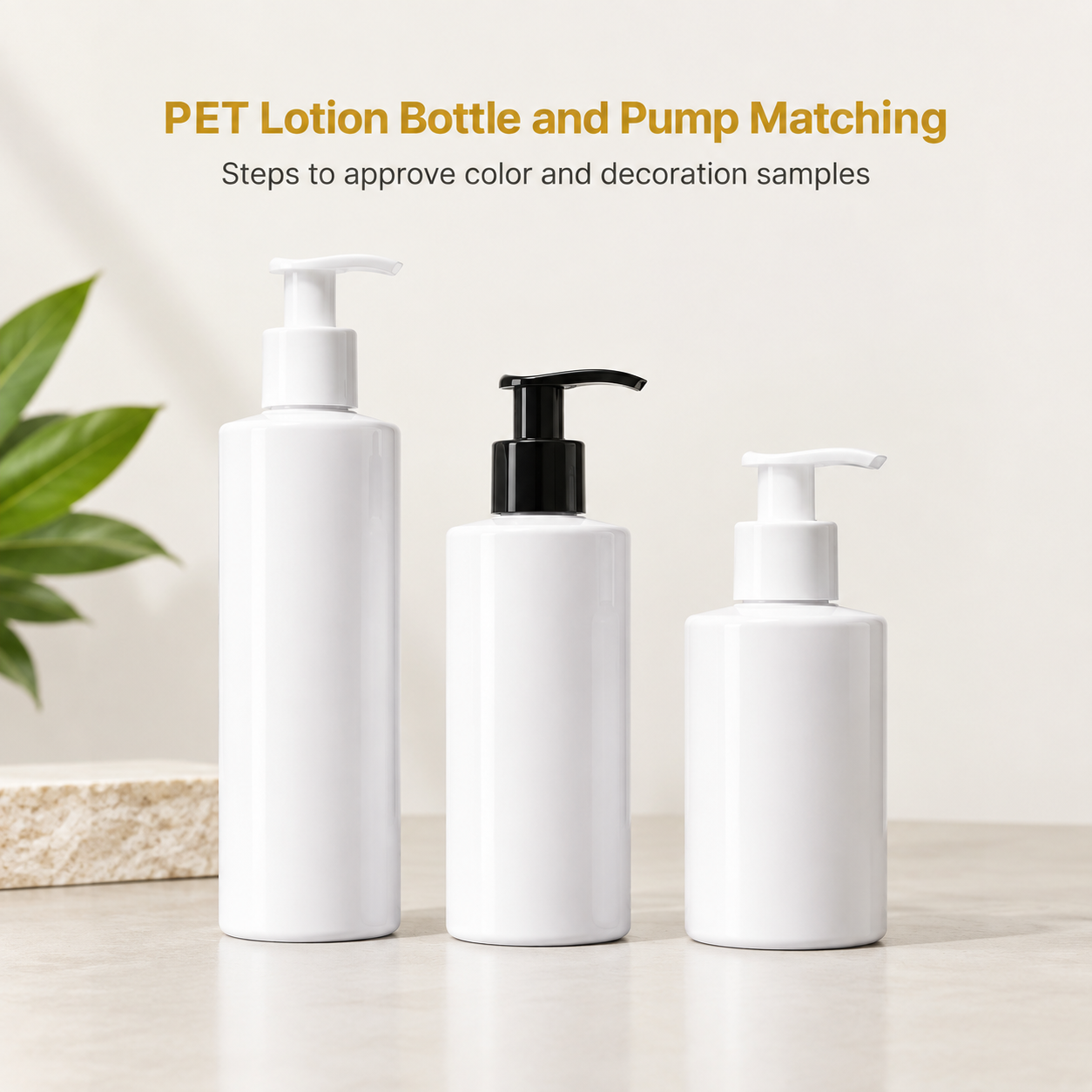
Color and decoration approval should move from a documented brief to a signed physical standard. The exact sequence can vary with a stock bottle, custom mold, resin color, coating and decoration method.
- Define the complete package. Record the bottle capacity, dimensions, PET construction, neck finish, pump or cap, dip-tube requirement, formula viscosity context and filling method.
- Set the appearance reference. Provide a physical bottle, color chip or recognized color specification. Identify whether the target is clear, translucent, opaque, gloss, satin or matte.
- Submit production artwork. Supply editable files, print dimensions, spot-color references, finish callouts and the required orientation relative to the pump.
- Review an undecorated component sample. Check shape, fit, color direction, fill visibility, pump engagement and basic line handling before investing in decorated samples.
- Approve the decorated sample. Examine color, opacity, gloss, print registration, foil or label position, adhesion and appearance after normal handling.
- Test the assembled pack. Fill representative samples and evaluate dispensing, leakage risk, dip-tube reach, closure fit and formula-contact compatibility under a project-appropriate protocol.
- Sign and retain a master sample. Document acceptable tolerances and keep an approved bottle, pump and decoration assembly for production comparison.
Different bottle colors may share the same closure only when the neck finish and other interface dimensions match. Even then, the pump’s gasket, dip tube, dosage, color and formula-contact materials must suit the application. Review Opciones de bombas y tapones para productos cosméticos when specifying the assembled package.
When formula or light-exposure checks are needed
An amber-colored PET bottle does not guarantee light protection. The visible shade does not establish how much ultraviolet or visible light passes through the bottle, and protection requirements depend on the formula, colorant system, bottle wall, exposure conditions and intended shelf life.
Ask the formulator or responsible testing party whether the formula is light-sensitive and what wavelengths or exposure limits matter. If protection is required, define measurable acceptance criteria and test the intended bottle rather than extrapolating from appearance. The same principle applies to black, blue, white and decorated bottles.
Formula compatibility also remains separate from color selection. Use representative formula and production-intent components to assess changes such as stress cracking, swelling, discoloration, odor transfer, leakage, pump output or decoration damage. Conditions and duration should reflect the filling process, distribution route and expected storage. YBJ Packaging can discuss samples and packaging options, but approval criteria and results remain project-dependent.
Lista de comprobación para consultas y preguntas frecuentes
A useful inquiry gives the supplier enough information to evaluate the bottle, closure, decoration and production route as one package. Include the following details:
- Product type and formula or viscosity context, including known light sensitivity
- Target capacity, bottle dimensions and preferred shape
- PET material preference and clear, matte white, black, blue or amber appearance
- Required transparency, opacity and gloss or matte level
- Neck finish, closure type, pump dosage and locking requirements
- Decoration method, print area, artwork files and color references
- Estimated order quantity and whether a stock bottle or custom mold is being considered
- Filling application, filling temperature and filling-line constraints
- Mercado de destino, requisitos de embalaje y fecha prevista
- Requested component, decorated or filled compatibility samples
Send physical color and finish references when matching is important. Photographs are helpful for context, but screen settings and lighting make them unsuitable as the only production standard. MOQ, tooling, pricing, sampling, production time and shipping depend on the selected bottle, decoration, quantity, destination and approval requirements.
Comenta tu envase cosmético personalizado
The right bottle appearance is the one that supports the brand brief while remaining compatible with the formula, dispensing system, decoration and filling process. Treat clear, matte white and colored PET as sample decisions supported by defined references and an approved assembled pack.
Share the intended formula context and appearance with YBJ Packaging for a project review. Final compatibility, color tolerance, component availability, MOQ, tooling, price, production time and shipping plan must be confirmed for the selected specification.
Preguntas frecuentes
Does an amber-colored PET bottle guarantee light protection?
No. Amber is a visual color description, not proof of a specific light-transmission result. If the formula is light-sensitive, establish measurable requirements and test the intended PET bottle, color process and decoration under relevant exposure conditions.
How should a buyer approve a matte finish?
Approve a physical sample made with the intended bottle material, color and finishing process. Review gloss level, opacity, tactile feel, fingerprints, scuffing, decoration registration and closure matching under controlled lighting, then retain a signed master sample.
What should be checked before choosing a clear PET lotion bottle?
Check the formula’s visible color, stability, tendency to separate, residue appearance and sensitivity to light. Also evaluate PET compatibility, resin clarity, scuff visibility, fill-level consistency, artwork contrast and the appearance of the dip tube through the filled bottle.
Can different bottle colors share the same closure?
Potentially, but color does not determine fit. The bottles must have matching neck finishes and interface dimensions. Confirm the pump gasket, dosage, dip-tube length, locking function, color match and formula-contact materials for each assembled package.
What color and decoration references should be sent with an inquiry?
Send a physical master bottle or color chip where possible, a recognized color reference, editable artwork, identified spot colors, decoration dimensions, gloss or matte requirements, and photographs of the intended assembled appearance. State which reference takes priority if they differ.
Comenta tu envase cosmético personalizado
Tell YBJ Packaging what you are filling, the package format and capacity you need, your material and decoration preferences, estimated quantity, destination and target date. Include the formula or viscosity context, dimensions, closure or pump, filling application and desired color reference. The team can review the brief, discuss samples or compatibility requirements and suggest practical OEM or ODM packaging options for your project.

 English
 Français
 Español
