



Índice
- Short answer: approve the decorated bottle as a complete assembly
- Define the custom printed glass dropper bottle brief
- Print area, curved surface and logo placement
- Bottle color, ink opacity and brand color requirements
- Decoration routes to discuss with a glass packaging manufacturer
- Silkscreen logos on amber and other colored glass
- Double-side printing and multi-position artwork
- Comparison table: decoration choice, visual effect and approval issue
- Prepare artwork files and production instructions
- How to review decoration samples before bulk production
- Check color, registration, coverage and print position
- Inspect the decorated bottle with the dropper and collar installed
- What to include in a custom decoration inquiry
- Product references for your custom printed dropper bottle project
- How YBJ Packaging supports custom design, decoration and assembly coordination
- Preguntas frecuentes
- Request a custom printed dropper bottle sample
Custom printed glass dropper bottles should be approved as a complete decorated assembly, not only as a flat artwork file or empty glass container. This guide explains how to define the print area, select a decoration route, prepare production artwork, review samples and send a useful inquiry to an OEM or ODM packaging manufacturer.
Short answer: approve the decorated bottle as a complete assembly
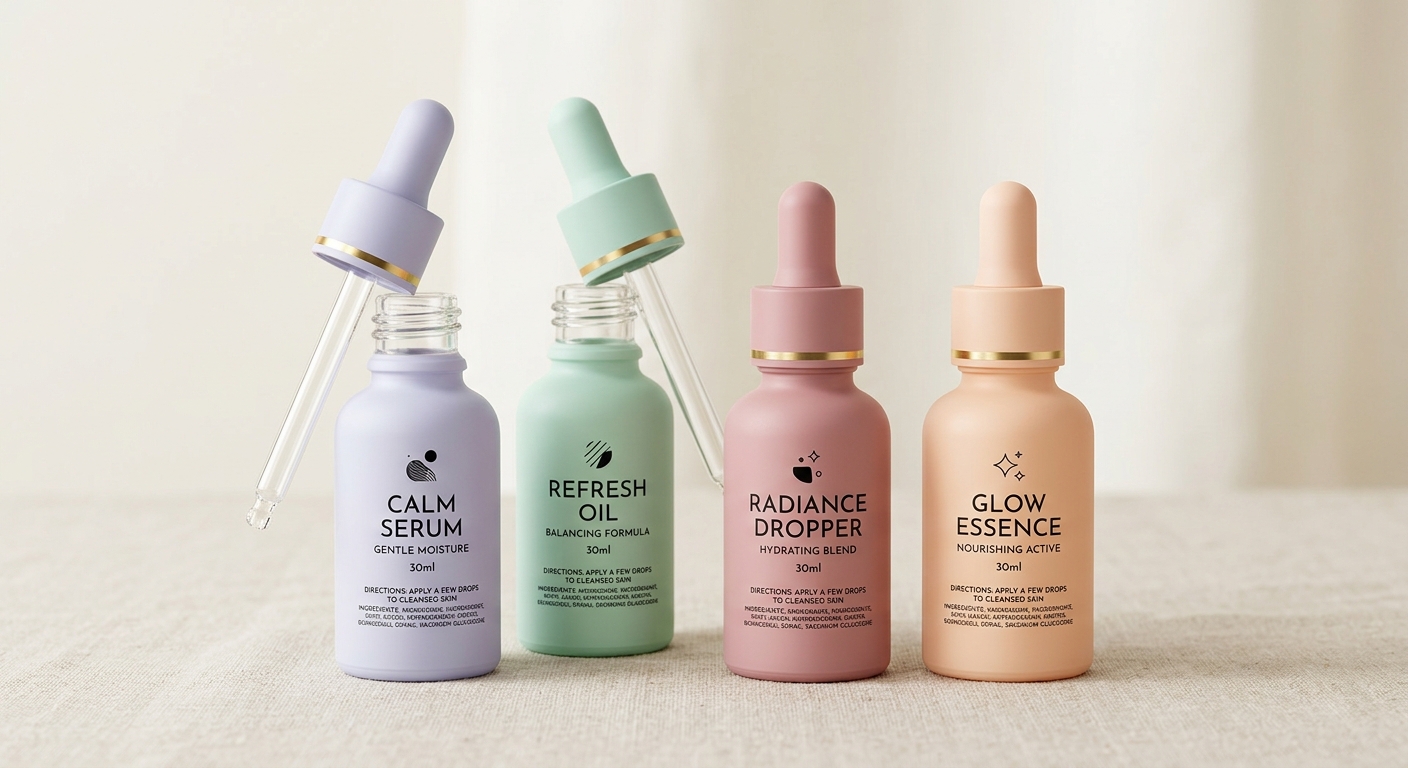
Respuesta directa: Develop custom printed glass dropper bottles by approving the artwork on the actual bottle shape, then reviewing the finished decoration with the dropper insert, pipette, bulb, collar and overcap installed. A logo that looks correct on a flat screen or on an empty bottle can appear too low, partially hidden, misregistered or visually unbalanced after assembly.
The safest development sequence is to lock the bottle and closure interface first, map the printable area, select the decoration route, prepare separated artwork files, produce a decorated sample and approve that sample against written criteria. If the bottle will contain a serum, facial oil or essential-oil product, review the filled and assembled package as a separate compatibility and handling step. Decoration approval alone does not establish formula compatibility, leakage performance or shipping suitability.
- Define the package: state the glass color, nominal capacity, fill target, bottle dimensions, dropper components, neck finish and decoration requirements.
- Map the artwork: identify the front panel, back panel, curved-area limits, keep-out areas and the position of every logo, text block and regulatory or commercial mark.
- Choose the route: compare direct glass bottle silk screen printing with digital or UV printing, foil, coating, labels or other project-appropriate methods.
- Approve a physical sample: inspect color, opacity, registration, coverage, print height, orientation, rub resistance and appearance under practical lighting.
- Approve the complete assembly: install the dropper and collar before making the final visual decision, and document the approved sample for production reference.
Exact ink selection, print limits, decoration durability, component compatibility, minimum order quantity, tooling, pricing, production timing and shipping depend on the bottle, formula, quantity, process and destination. Confirm each item with the supplier before placing a bulk order.
Define the custom printed glass dropper bottle brief
A decoration supplier cannot accurately assess artwork from a logo file alone. The brief should describe the complete packaging system and the visual result you need. This prevents a common sourcing problem: the brand approves an attractive graphic, but the chosen bottle, closure, print area or production process cannot reproduce it in the intended position.
Start by separating fixed requirements from items that are open to recommendation. Fixed requirements may include the brand color, legal text, logo proportions, bottle color, target fill, launch market and delivery destination. Open items may include the bottle shape, screen-printing method, number of ink colors, collar finish, pipette length and whether the graphic should be printed directly or applied as a label.
Terms to establish before artwork development
- Print area
- The usable surface where decoration can be applied consistently. The supplier should identify whether the area is flat enough, cylindrical enough or sufficiently accessible for the proposed process.
- Acabado del cuello
- The dimensional interface at the bottle opening, including the thread and opening geometry, that determines whether a dropper closure can be assembled and sealed correctly. Review the supplier drawing and physical sample rather than selecting a dropper by outside appearance only. See the Guía sobre los tipos de boca de los frascos cosméticos for the information normally required.
- Registration
- The alignment of one printed element with another element or with a defined feature on the bottle. It matters when a logo, border, front panel and back panel must line up visually.
- Opacity
- How much the ink hides the color or transparency of the glass beneath it. A pale ink on amber or tinted glass may need a different ink system or an underprint to reach the intended appearance.
- Posología
- The approximate amount dispensed by one use of the dropper. It depends on the pipette, bulb, formula viscosity, fill level and user technique, so it should not be inferred from bottle capacity.
- Cleanroom
- A controlled production area designed to limit airborne particles. A cleanroom supports controlled assembly conditions, but it does not by itself prove that a particular ink, bottle or formula is compatible.
For the first supplier discussion, specify the bottle type as a glass dropper bottle and state whether the intended product is a serum, oil, fragrance-related product or another personal-care formula. The product category helps the manufacturer ask relevant questions about contact surfaces, filling, handling and decoration exposure without requiring you to disclose confidential formula details immediately.
Include the nominal bottle capacity and the intended fill volume separately. A 30 mL nominal container, for example, may not be filled to the shoulder, and the visible liquid line can change the way a translucent print and label area appear. Also state whether the bottle will be sold with a protective carton, because the carton may cover part of the bottle decoration during retail presentation.
Print area, curved surface and logo placement
Glass dropper bottles often have a round shoulder, cylindrical body, curved base transition and a narrow neck. These changes in geometry affect how a printed design is viewed and how a decoration tool reaches the surface. The printable area is therefore a packaging specification, not simply a rectangle copied from a brand guideline.
Ask the manufacturer for a current bottle drawing or a physical blank sample before finalizing the artwork. The drawing should show the body diameter, overall height, shoulder transition, base ring, neck and any areas that must remain free for assembly or handling. If the bottle has a square, oval or faceted profile, request a surface map that identifies each visible panel. Do not assume that a design prepared for a cylindrical bottle will transfer directly to a faceted bottle.
Map the visible panels
- Front panel: define the centerline from the consumer viewing direction and identify the visual center of the brand mark.
- Back panel: allocate space for product information, directions, origin details or other required text according to the destination market and brand review.
- Shoulder and base: treat rounded transitions as higher-risk areas for distortion, uneven coverage or loss of readability.
- Neck and thread: keep decoration away from the closure interface unless the supplier specifically confirms that the proposed process and assembly sequence support it.
- Handling zones: consider where fingers, filling equipment, trays, cartons and the dropper collar contact the bottle.
On a round bottle, a wide graphic may wrap beyond the intended viewing angle. This is not necessarily a registration defect; it may be a consequence of the artwork width and body circumference. Ask for a visual mockup showing the design at the front, three-quarter and side views. For a narrow bottle, reduce visual density before reducing text legibility. Tiny copy, thin strokes and close-set borders can lose clarity when reproduced on a curved surface.
Logo height should be reviewed with the installed closure, not only with the bottle body. A tall collar or overcap can hide the top of the design, while a short collar can expose more empty glass than expected. If several bottle sizes will share one graphic system, request separate artwork maps rather than scaling one file automatically. Body diameter, shoulder height and available print band may change between sizes.
For artwork approval, mark the print origin and viewing direction on the drawing. State whether the front is defined by a molding mark, a seam, a bottle panel or the position of the dropper collar. If the bottle rotates during filling or consumer use, decide whether a single orientation is required or whether the design should be visually balanced around the full circumference.
Bottle color, ink opacity and brand color requirements
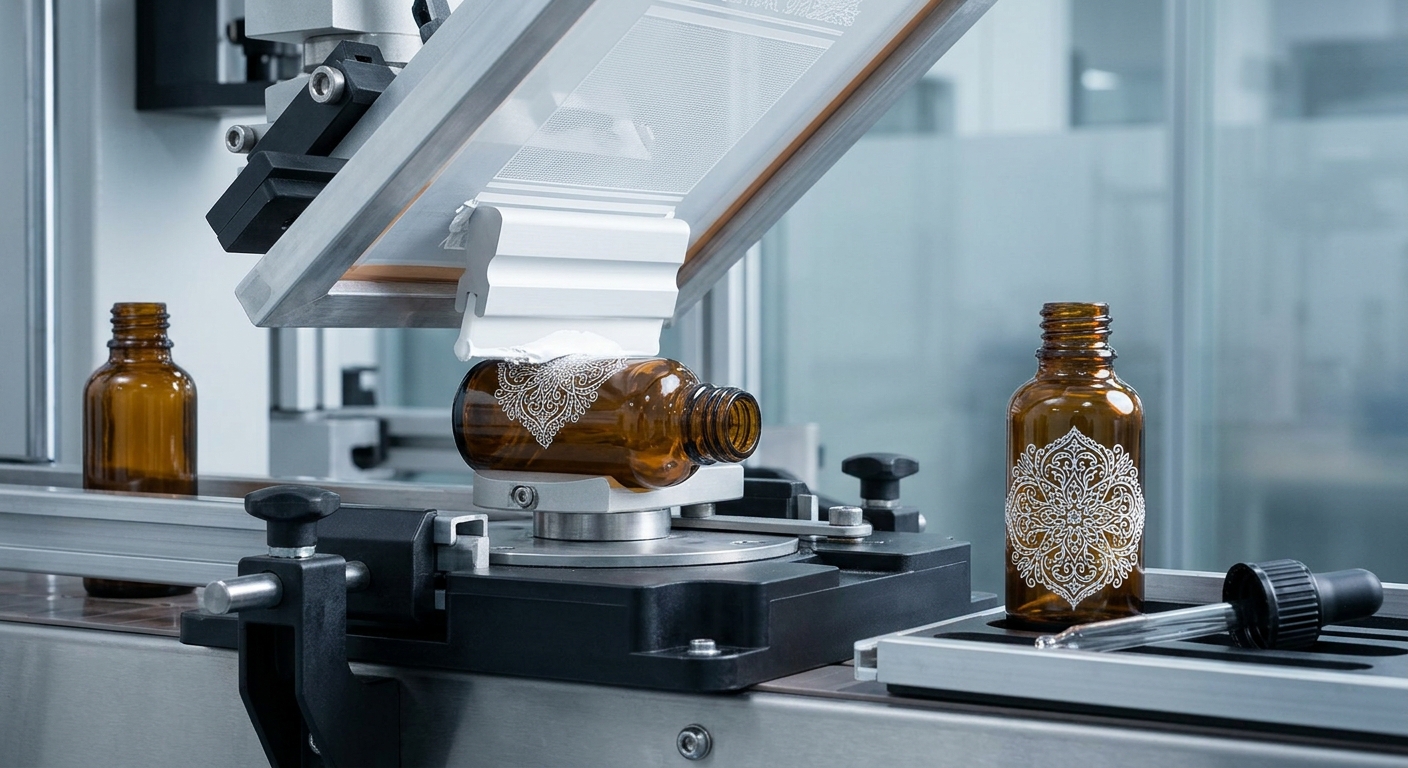
Glass packaging color matching is a layered decision. The visible result is influenced by the glass color, frosting or coating, ink color, ink opacity, number of print passes, curing method, surrounding colors and the color of the formula seen through or behind the glass. A digital proof on white paper cannot reproduce all of these variables.
Clear glass normally provides the greatest visibility into the formula and can support a wide range of decoration approaches, but transparent or light inks may appear weak unless the design uses a suitable underprint or high-contrast treatment. Amber glass changes the appearance of pale colors and can make warm tones appear deeper. Blue, green, black or opaque coated glass can also shift the perceived color of the same ink. Frosted or sprayed surfaces change reflection and texture, which may improve the premium appearance but create additional questions about print adhesion and surface consistency.
When color is commercially important, give the supplier a recognized color reference such as a Pantone target, a physical brand standard or an approved printed reference. Treat that reference as a communication tool, not as a guarantee that the ink will look identical on every glass color. The final decision should be made on the actual bottle or an equivalent production surface under agreed lighting conditions.
Specify opacity deliberately
- Solid opaque print: useful when the logo must remain readable against a dark or transparent background. Ask whether a white underbase is needed and whether it changes the apparent color of the top layer.
- Translucent print: allows some glass or liquid color to influence the visual effect. This can be attractive for a light, minimal design but should be checked at different fill levels.
- Metallic or reflective ink: can create a high-contrast accent, but reflection, viewing angle and adjacent decoration influence readability.
- White print: should be checked for coverage, edge definition and interaction with colored glass. Multiple passes may alter thickness, texture or production timing.
For printed essential oil bottles, ask the supplier to evaluate the actual formula context and handling environment. Oils, alcohol-containing products, fragrance vapors, leakage, wiping and repeated consumer contact can affect the appearance of some decoration systems over time. Do not approve the ink only from an empty-bottle photograph if the product will be filled, wiped or exposed to the formula during normal use.
Document the required visual conditions in the approval record: bottle color, fill state, cap and collar color, light source, viewing distance and whether the sample is wet, dry, assembled or unassembled. This creates a more useful production reference than a color name alone.
Decoration routes to discuss with a glass packaging manufacturer
The best decoration route depends on the artwork, bottle geometry, target quantity, required appearance, filling process and destination. Direct glass bottle silk screen printing is often considered for strong logos, simple text and repeatable brand panels, but it is not automatically the right answer for every graphic. Gradients, photographic effects, very small copy, multiple colors and variable data may lead to a different recommendation.
Discuss the route with a supplier that can evaluate the bottle, closure and assembly together. The supplier should clarify which operations are performed directly by its own facility, which are coordinated with a decoration partner and which require separate approval. YBJ Packaging describes one-stop support from consultation and design through material selection, manufacturing, assembly, quality checks and worldwide shipping. The exact decoration process and production allocation for each project should still be confirmed in writing.
Useful route categories to compare include:
- Direct screen printing: ink is transferred through a prepared screen onto the glass. It is commonly discussed for bold logos and spot-color graphics, but screen count, curved geometry, ink opacity and curing must be reviewed.
- Digital or UV printing: may support more complex artwork or short-run sampling where available. Confirm the ink system, surface preparation, color process, cure method and resistance requirements rather than assuming that the word UV describes the final bottle performance.
- Hot stamping or foil: can provide a reflective accent or metallic mark. Check whether the bottle surface, artwork size, pressure, heat and assembly handling are suitable.
- Surface coating followed by printing: can change the base color and visual texture before the logo is added. Confirm coating consistency, print adhesion and how the finish behaves during filling and packing.
- Label or sleeve decoration: can accommodate complex graphics and variable information, but changes the tactile result, seam visibility, recyclability considerations and interaction with the bottle profile.
For a practical overview of process differences, review the guía de técnicas de decoración de envases cosméticos, then ask the manufacturer to recommend a route for your actual glass and artwork. The recommendation should be based on an approval sample, not only on a stock photograph.
Silkscreen logos on amber and other colored glass
Glass bottle silk screen printing places ink directly on the bottle through a mesh screen. Each artwork color generally requires its own prepared color separation and production setup, although the exact process varies by supplier and decoration system. On a single-color logo, this route can create a clean, direct-to-glass appearance. On a multi-color design, the approval focus expands to color sequence, registration, overlap and the interaction between layers.
Amber glass is a frequent consideration for serum, oil and fragrance-related packaging because its warm base affects the appearance of printed ink. A pale logo may need stronger opacity or an underbase to remain visible. Conversely, a dark logo may lose contrast against amber. The supplier should show a physical drawdown or decorated bottle using the proposed glass and ink combination.
What to ask about a screen-printed decoration
- Surface preparation: ask how the bottle is cleaned or prepared before printing and whether the surface treatment is compatible with the proposed ink.
- Ink system: identify whether the ink is intended for glass and request the supplier recommendation for the required visual and handling conditions.
- Curing: confirm the curing method and the time between printing, assembly, packing and filling. A process description is more useful than an unsupported durability claim.
- Color layers: clarify the order of colors, whether a white underprint is planned and how overprinting changes the final appearance.
- Print boundaries: confirm the usable height and circumference, especially if the design approaches the shoulder, base or collar.
- Inspection criteria: agree how to judge pinholes, smears, scratches, exposed glass, uneven edges, color variation and position.
Screen printing is not a substitute for a package-level test. If the bottle will be wiped, placed into a carton, run through a filling line or handled repeatedly by consumers, include those conditions in the evaluation where relevant. The acceptable result may be different for a short-term sample, a retail bottle and a professional-use container.
Ask for a written production reference that identifies the approved bottle color, ink appearance, print locations and assembly configuration. If the brand has several glass colors, approve each combination separately. Using one approved white logo sample as a universal reference for clear, amber and coated glass can lead to inconsistent results.
Double-side printing and multi-position artwork
Double side printing on a cosmetic bottle normally means that two separate viewing panels, such as a front and back, receive decoration. On a round glass dropper bottle, the two panels may be opposite each other or positioned at a defined rotational angle. That angle must be shown on the bottle drawing; the phrase front and back is not precise enough for production.
A double-sided design requires more than duplicating the logo. The artwork package should identify the front centerline, back centerline, reading direction, vertical print origin, color layers and the relationship between each panel and the dropper collar. If the back contains small text, confirm that it remains readable when the bottle is held naturally and that the front decoration does not show through in an unwanted way.
Approval points for a double-side printing cosmetic bottle
- Rotational position: place the bottle on a defined reference surface and verify that the front and back panels sit at the intended angle.
- Vertical position: compare the distance from the base, shoulder and collar to the approved drawing.
- Panel width: check whether the artwork wraps around the side edges or leaves the intended amount of glass visible.
- Color interaction: inspect whether the reverse-side ink changes the apparent color when viewed through clear or translucent glass.
- Assembly relationship: install the dropper and overcap to ensure that the front panel still faces the expected direction and is not partly hidden.
- Production sequence: ask whether the panels are printed in one setup, separate setups or separate passes, and what that means for registration and handling.
Multi-position artwork can also include a shoulder mark, base mark, vertical side text or a small icon near the neck. Each additional position should be shown on a bottle map. Avoid sending a single flat image with no indication of which elements belong to which surface. A supplier may need to rebuild the file into process layers before sampling.
For a premium result, approve a sample while rotating it slowly under neutral light. Check whether the logo remains balanced at the front, three-quarter and side views. If the design is meant to be read from a single direction, identify the direction on the packaging drawing and consider how the filled bottle will be placed in its carton or retail tray.
Comparison table: decoration choice, visual effect and approval issue
The table below is a sourcing framework rather than a promise that every route is available for every bottle. Ask the manufacturer to assess the actual glass surface, artwork, quantity and filling environment before selecting a process.
| Decoration route | Visual effect and useful fit | Main approval issue | Information to confirm |
|---|---|---|---|
| Direct glass screen printing | Direct, clean logo or spot-color graphic; often considered for simple branding and strong text. | Color and opacity can change on amber, frosted or coated glass. Curved surfaces may limit small details. | Screen count, color layers, underbase, print area, surface preparation, curing and inspection criteria. |
| Digital or UV printing | May support more complex artwork, multiple colors or sampling flexibility where the process is available. | Surface compatibility, cure quality, color reproduction and resistance must be evaluated on the proposed bottle. | Ink system, resolution limits, color process, cure method, minimum graphic size and package-level test plan. |
| Hot stamping or foil | Reflective metallic accent or focused premium detail. | Fine detail, adhesion, heat, pressure and handling can affect the result, especially on curved or treated surfaces. | Foil color, print size, surface finish, temperature or pressure requirements and rub evaluation. |
| Coating plus print | Creates a colored or tactile base before the logo is applied. | Base-color consistency, edge coverage, scratching and interaction between coating and ink require review. | Coating specification, gloss or matte target, color reference, curing, handling and filled-package inspection. |
| Label or sleeve | Useful for detailed graphics, variable information or artwork that exceeds direct-print limitations. | Seam, edge lift, wrinkles, placement, bottle curvature and contact with oils or moisture may affect appearance. | Label material, adhesive, dimensions, seam position, application method, environmental exposure and carton fit. |
Direct printing usually provides a different tactile and visual result from a label, while a label may offer more flexibility for complex artwork or later artwork changes. A foil mark may look more reflective than a standard ink but can require tighter process control. The correct comparison is not only appearance: include sample lead time, setup requirements, expected inspection points, filling-line handling, carton clearance and the destination market’s packaging requirements.
If the project is a launch with several artwork revisions, ask whether a sampling route and a bulk-production route will be identical. A digital sample may help evaluate layout, but the final screen-printed production bottle may require a separate approval. Record which process, ink, glass color and closure configuration the approved sample represents.
Prepare artwork files and production instructions
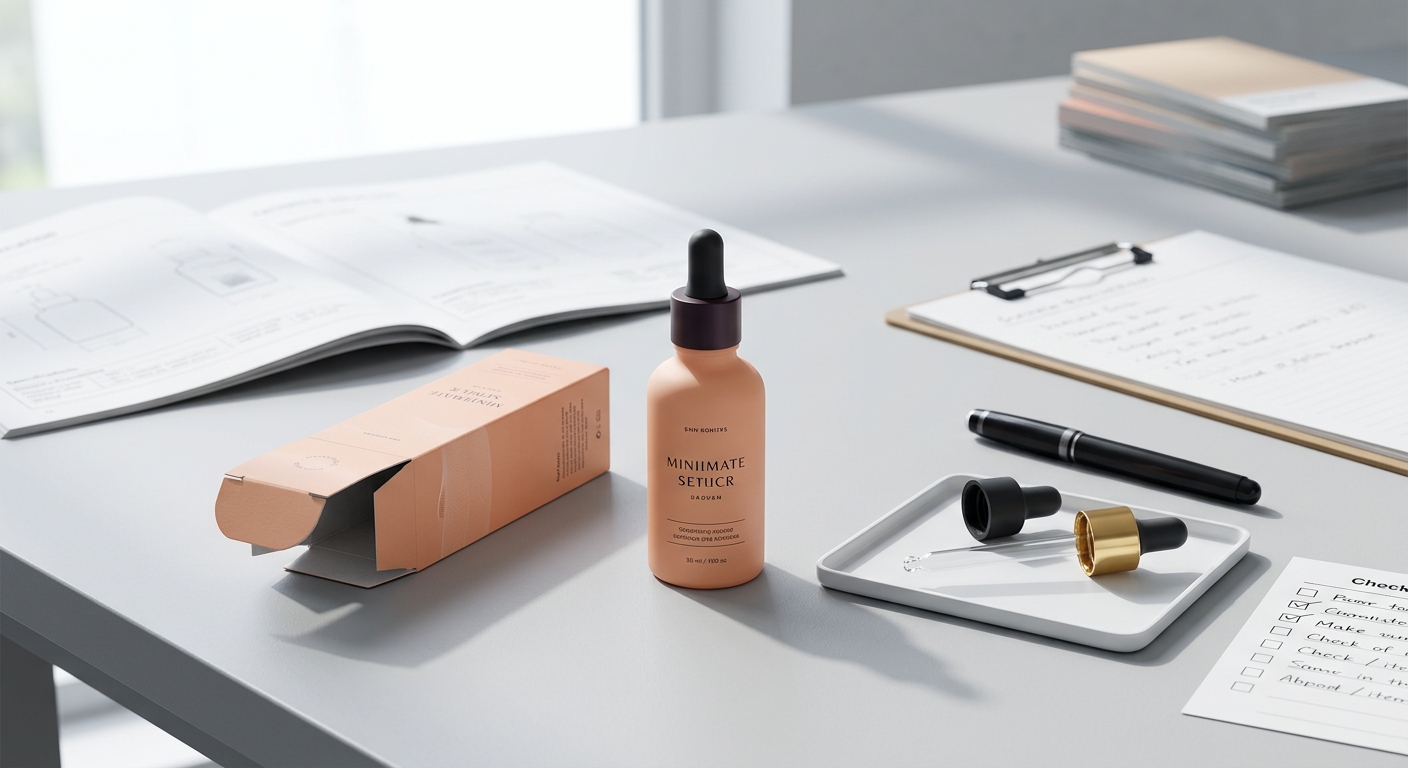
Artwork is ready for decoration development when the manufacturer can identify every color, surface, direction and production layer without guessing. Send an editable vector file whenever possible, together with a marked-up visual that shows how the design should appear on the assembled bottle.
Recommended artwork package
- Editable master: provide AI, EPS, SVG or an editable PDF, subject to the supplier’s preferred file format. Convert fonts to outlines or include the font files and identify the intended typeface.
- Color separation: separate each spot color or process layer and label whether it is a top color, underbase, overprint or special-effect layer.
- Print map: show the front, back, side, shoulder and base positions on a current bottle drawing. Add dimensions or reference marks supplied by the manufacturer.
- Viewing direction: mark the front centerline, back centerline and reading direction. Show the position of the dropper collar and any logo that must face forward.
- Text hierarchy: distinguish the logo, product name, shade or variant, capacity statement and other text. State which elements are fixed and which may be adjusted for legibility.
- Opacity instruction: state whether the print should be opaque, translucent, metallic, matte, glossy or supported by a white underbase. These are visual targets for technical review, not automatic process specifications.
- Reference colors: include Pantone references, physical swatches or an approved brand standard. State the lighting condition for final color review if your brand has one.
- Variant matrix: list every bottle color, scent or formula variant and identify which artwork elements change. Do not rely on file names alone.
- Approval status: mark the file as concept, sampling artwork, revised artwork or approved production artwork. This reduces the risk of an obsolete file being used.
Do not build the final design using a stock bottle photograph as the only layout reference. A photograph may have perspective distortion, an inaccurate scale or a different closure. Use it for visual direction, then rebuild the production design against the supplier’s drawing and blank sample.
Ask the supplier to flag small text, thin strokes, tight spacing, reversed type, gradients and artwork that approaches the bottle shoulder or base. The supplier may recommend a size or spacing change to improve readability. Keep a record of any approved adjustment rather than silently modifying the brand file.
For a design with white ink over amber glass, specify whether the white should be a separate opaque layer or whether the top color is expected to cover the glass on its own. For a translucent effect, show a filled-bottle mockup because the formula color and fill line may alter the appearance. For metallic details, identify the acceptable balance between reflectivity and legibility.
Before sampling, request a proof that contains the bottle outline, print boundaries, color layers, front and back views and installed closure. The proof is a communication document. The physical decorated sample remains the more useful reference for color, coverage, surface texture and assembly appearance.
How to review decoration samples before bulk production
A dropper bottle sample approval should be a controlled comparison, not an informal decision based on one product photograph. Ask for a sample that represents the proposed bottle color, decoration process, ink or coating, closure components and assembly sequence. If any of these are different from the planned production package, record that limitation.
Use a simple review sequence so the brand, packaging supplier, filling team and quality team judge the same features:
- Confirm the sample identity: record the bottle model, capacity, glass color, closure parts, artwork revision, decoration route and sample date.
- Review the bottle empty: inspect the glass, decoration and print location from the front, back, side and base. Photograph the sample under neutral, consistent lighting if internal records require images.
- Review the bottle filled or simulated: where practical, use the intended fill state or a representative liquid color to see how transparency, show-through and the fill line affect the design.
- Check the complete assembly: install the pipette, bulb, collar and overcap as they are expected to appear in the final package.
- Evaluate handling: consider contact with fingers, trays, filling equipment, cartons, dividers and any cleaning or wiping step used before shipment.
- Compare against the brief: check the approved drawing and artwork file line by line, including text, variant name, capacity statement and orientation.
- Record decisions: list accepted items, required corrections, open tests and the sample that will become the production reference after final approval.
Separate visual approval from performance approval. Visual approval covers the position, color, opacity, coverage, registration and overall appearance of the decoration. Performance approval may require a different evaluation of ink adhesion, rub resistance, filled-formula exposure, filling-line contact, carton abrasion or shipping conditions. The supplier and brand should decide which tests are relevant to the intended use.
Do not approve a sample solely because the logo is centered. A centered logo can still have poor edge definition, inconsistent opacity, a hidden top line, an incorrect back-panel angle or a closure color that changes the brand impression. A complete review protects the bulk order from avoidable artwork and assembly disputes.
Check color, registration, coverage and print position
Use a written inspection checklist for the decoration itself. The supplier may have its own quality standard, but the brand should state the visual features that are commercially important. Do not create universal pass or fail tolerances without discussing the process; suitable limits depend on bottle geometry, decoration method, artwork size and inspection conditions.
- Color: compare the printed area with the approved physical reference on the same glass color. Look at the main color, underbase, overprint and metallic or translucent effects separately.
- Opacity and coverage: check the center and edges of solid areas for visible glass, thin spots, pinholes or uneven density. A translucent design should be judged against its intended level of show-through rather than treated as defective by default.
- Registration: inspect the alignment of multiple colors, borders, white underbase and front or back panels. Use the defined bottle centerline and print origin.
- Position: measure or compare the vertical location relative to the base, shoulder, collar and other approved reference features. Check that the design is not unintentionally rotated.
- Edges and detail: inspect small text, thin lines, corners, reversed text and fine symbols for spreading, breaks or loss of definition.
- Surface defects: look for smearing, scratches, dust inclusions, bubbles, exposed glass, unwanted marks and inconsistent gloss or texture.
- Variant consistency: compare all colors and artwork versions side by side so that a change in glass or formula does not create an unplanned visual mismatch.
Review samples under more than one practical condition, such as neutral indoor light and the lighting used for internal brand approval. Avoid judging color from a phone photograph or from a screen with unknown calibration. A photograph can document a sample, but it is not a reliable substitute for seeing the physical decorated glass.
If the sample is rejected, describe the defect and the desired correction precisely. For example, state that the back panel is rotated from the agreed centerline, that the white underbase is too transparent on amber glass or that the lower line is hidden by the collar. A clear correction request is more useful than asking the supplier to make the bottle look more premium.
Inspect the decorated bottle with the dropper and collar installed
The dropper assembly changes the visual frame around the bottle. A colored bulb and collar can make a logo appear smaller, warmer, cooler, lower or less legible. The closure may also cover the upper print boundary or create a shadow that is not visible when the bottle is inspected empty.
Assemble the sample using the same component colors, surface finishes and general construction intended for production. Check whether the pipette is centered, whether the collar sits at the intended height and whether the overcap leaves the expected amount of the printed body visible. If the dropper includes a glass pipette, inspect the visual relationship between the pipette, liquid line and printed panel. Any change to the closure, collar height or component color should trigger a new visual review.
Also check the functional interface without treating decoration review as a substitute for a closure test. The dropper should be evaluated for fit, thread engagement, insertion, removal and dispensing using the formula or a suitable representative liquid. Dosage can change with viscosity, pipette dimensions, bulb construction and user technique. A satisfactory visual sample does not establish a specific dose or leak result.
For filling operations, ask the packaging team to review how the assembled bottle is oriented, gripped and transferred. Decoration near the base or shoulder may contact guides or trays. Ink or coating that looks correct at rest may require additional handling review if the filling line rotates or clamps the bottle. Confirm the filling application, line contact points and any post-fill wiping or inspection step.
Approve the complete assembly only when the bottle, print, dropper, collar, overcap and intended presentation all match the project brief. Keep one signed or otherwise documented reference sample if the commercial process allows it, and identify its artwork revision and component specification.
What to include in a custom decoration inquiry
A complete inquiry helps a custom serum bottle manufacturer recommend a realistic bottle and decoration route. It also allows the supplier to separate a stock-bottle project from a custom-mold project and to identify which questions need a sample before quotation or production planning.
Send these project details
- Product type: identify whether the package is for a serum, facial oil, essence, fragrance-related product, essential oil product or another personal-care formula.
- Formula or viscosity context: provide the formula category, approximate viscosity or flow behavior and any relevant information about oils, alcohol, solvents, pigments or fragrance exposure. A confidential formula is not always required for the first inquiry, but the manufacturer needs enough context to plan compatibility discussion.
- Capacity and fill target: state the nominal capacity, intended fill volume, headspace expectations if known and the number of variants.
- Bottle dimensions: provide preferred height, diameter, profile, base and shoulder requirements, or request a suitable stock format if dimensions are not fixed.
- Material and glass color: identify clear, amber, frosted, coated, opaque or another appearance target. Confirm whether material and color are fixed or open to recommendation.
- Closure and pump details: for a dropper, specify the collar, bulb, pipette, overcap, color, finish and any existing neck-finish drawing. If the closure is not selected, state the desired appearance and dispensing context.
- Decoración: describe the logo, print sides, number of colors, opacity, metallic or matte requirements, print position, artwork dimensions and whether a label or direct print is acceptable.
- Artwork files: attach vector artwork, color references, a bottle map if available and a visual mockup of the assembled bottle. Mark the file revision.
- Estimated quantity: give an initial order estimate and any expected repeat orders without assuming that a supplier’s published or product-page wording establishes your project’s MOQ.
- Filling application: explain whether the bottle will be hand-filled, semi-automatically or filled on an automated line. Include relevant orientation, gripping, wiping and inspection information.
- Destination: state the destination country or region, shipping preference and whether the bottle is packed in cartons, dividers, trays or a retail box.
- Target date: provide the desired sample review date and target production or shipment window. These are planning targets, not guaranteed dates before technical review and approval.
- Approval plan: explain how many artwork or component versions may be reviewed, who signs off and whether filled-package, rub, handling or transport evaluations are required.
Example inquiry summary
Ask for a 30 mL glass dropper bottle for a medium-viscosity facial serum, with a defined glass color, a matching collar and bulb, one front logo and one back information panel, opaque white and one brand spot color, direct screen printing as the preferred route, an estimated quantity, the filling application, destination and target date. Request a bottle drawing, decoration recommendation, sample plan and a list of project-dependent items such as MOQ, tooling, pricing, production timing and shipping assumptions.
If you are considering printed essential oil bottles, identify the formula exposure and cleaning or wiping conditions early. If the artwork contains multiple languages or very small copy, send the final text and intended reading size before sampling. If the package has a carton, send the carton dimensions or a mockup so the decorated area and closure are reviewed in the actual retail presentation.
Product references for your custom printed dropper bottle project
YBJ Packaging has several relevant product listings that can help buyers begin a visual discussion. Use them as reference formats rather than as automatic confirmation of your required bottle construction. The final capacity, glass color, dropper components, decoration route, print colors, surface finish, MOQ, tooling, pricing and production timing must be reviewed for the specific project.

Low MOQ custom printed dropper bottles for startups
This listing is a useful starting point for a brand comparing decorated dropper formats at an early stage. Confirm what low MOQ means for your selected bottle, artwork, decoration process and component combination before relying on it for planning.

Vintage-style custom printed glass dropper bottles
This reference can support a discussion about amber or warm-toned glass, high-contrast white decoration and a classic presentation. Confirm the actual glass shade, ink opacity, print area and assembled closure before approving the look.

Custom printed UV glass dropper bottle set
This listing can be considered when the project includes a coordinated bottle and carton presentation. Confirm what UV refers to in the selected specification, along with the decoration method, glass treatment, closure parts and packaging configuration.
When contacting the supplier about one of these references, identify the listing title and state which features you want to retain or change. A reference image is helpful for style, but an approval sample must represent the actual material, artwork, decoration process and complete assembly intended for production.
How YBJ Packaging supports custom design, decoration and assembly coordination
YBJ Packaging is a China-based OEM and ODM cosmetic packaging manufacturer serving skincare, makeup and personal-care brands. The company describes a one-stop support process that covers consultation and design, mold development, material selection, manufacturing, assembly, quality checks and worldwide shipping. For a printed glass dropper project, this type of coordinated workflow can reduce handoffs between the bottle supplier, decoration provider, closure supplier, assembly team and logistics team.
YBJ Packaging states that it has more than 20 years of cosmetic-packaging experience, a 10,000 m² intelligent facility, a Class 10,000 cleanroom, 12 automated assembly lines and 23 Toshiba all-electric injection machines. These are company-provided capability facts. They should be understood as facility and service information, not as a project-specific guarantee of decoration performance, production timing, minimum order quantity or regulatory suitability.
The injection machines are relevant to molded packaging components, while the glass bottle itself follows a different manufacturing and decoration route. Ask YBJ to clarify which glass forming, coating, printing, inspection and assembly steps are performed directly, which are coordinated with a qualified partner and which require your approval at a separate stage. This distinction is especially important when the project requires custom glass color, multiple print layers, two-sided artwork or a special closure.
What to confirm with YBJ Packaging
- Whether the selected bottle is stock, modified or requires a new mold.
- Which glass color, surface treatment and closure options are available for the chosen format.
- Whether direct screen printing, digital or UV printing, foil, coating, labeling or another route is recommended for the artwork.
- How the artwork will be mapped to the bottle and how many physical samples are included in the review plan.
- Which inspection points cover print color, opacity, registration, position, surface defects and assembled appearance.
- Whether filling-line handling, formula exposure, wiping, carton packing or transport evaluations are needed for the project.
- How component sourcing, assembly, quality checks, export packing and worldwide shipping will be coordinated.
- The project-specific MOQ, tooling, pricing, production schedule and shipping assumptions after the specification is reviewed.
A supplier’s value is not only the ability to print a logo. It is the ability to translate artwork into a repeatable packaging specification and coordinate the decisions that affect the finished assembly. Give the supplier enough information to identify trade-offs early, and keep the approval sample, artwork revision and component list connected throughout the project.
Preguntas frecuentes
These answers address common sourcing questions about custom printed glass dropper bottles. The final recommendation remains dependent on the selected bottle, artwork, formula, quantity, decoration route and approval sample.
- Can every logo be screen printed directly onto glass? See the answer below about artwork limits and surface review.
- Is double-side printing possible on a round dropper bottle? It can be discussed, but the supplier must define the panel angle, registration method and print sequence.
- Should the brand approve an empty bottle or a complete assembly? The complete assembly should receive final visual approval, with separate functional checks where needed.
- Will a printed bottle work with an essential-oil formula? That requires a package-level review using the relevant formula and handling conditions.
- What should be sent for a quotation? Send the complete specification, artwork, quantity, filling, destination and timing information listed in this guide.
Request a custom printed dropper bottle sample
For a useful sample and quotation discussion, send YBJ Packaging your product type, formula or viscosity context, nominal capacity and fill target, preferred bottle dimensions and glass color, closure or dropper details, decoration route, artwork files, estimated quantity, filling application, destination and target date. State whether you need front-only, double-side or multi-position printing, and identify the physical sample approval criteria that matter most.
Ask the team to confirm compatibility, MOQ, tooling, pricing, production timing, inspection scope and shipping only after the project details and approval requirements have been reviewed. A sample or compatibility discussion can help resolve questions before bulk production, but the final specification should be approved in writing.
Preguntas frecuentes
Can any artwork be used for glass bottle silk screen printing?
No. The artwork must suit the bottle geometry, print area, selected ink system and decoration process. Very small text, thin strokes, tight spacing, gradients and designs that reach the shoulder or base may require adjustment. Send vector artwork and ask the supplier to identify process limits before sampling.
Can a round cosmetic bottle have double-side printing?
Double-side printing can be considered when the supplier can define the two panels and control their rotational and vertical position. Provide front and back centerlines, reading direction and the relationship to the dropper collar. Approve both panels on the assembled bottle because the closure can change the apparent alignment.
Why is complete assembly approval necessary?
The dropper bulb, collar, pipette and overcap change the visible frame around the printed body. They may hide part of the artwork, change color balance or affect the intended front orientation. Approve the complete assembly for appearance, then perform separate fit, dispensing, formula compatibility and handling evaluations when required.
Can screen printing be used for printed essential oil bottles?
It may be suitable, but it should not be assumed to be compatible with every essential-oil formula or handling condition. Review the actual glass, ink, curing process, formula exposure, leakage risk, wiping, consumer contact and packing conditions with the supplier. A visual approval sample alone does not prove long-term decoration performance.
What does glass packaging color matching involve?
It involves comparing the glass color, ink color, opacity, underbase, surface finish, fill state and lighting conditions. A Pantone reference or physical brand standard helps communicate the target, but the final decision should be made on the actual decorated bottle or an equivalent production surface. Clear, amber and opaque glass can make the same ink appear different.
Does an approval sample confirm the final MOQ, price or delivery date?
No. A sample establishes a visual or technical reference for the reviewed configuration. MOQ, tooling, price, production time and shipping depend on the bottle, components, decoration, quantity, destination and approval status. Request a project-specific quotation and schedule after the specification has been reviewed.
What information should I send to a custom serum bottle manufacturer?
Send the product type, formula or viscosity context, capacity, fill target, dimensions, material and glass color, neck finish or closure details, decoration requirements, vector artwork, estimated quantity, filling application, destination and target date. Also state whether you need a sample, compatibility discussion, carton coordination or a complete assembly review.
Request a project review for custom printed glass dropper bottles
Send your artwork and packaging brief to YBJ Packaging for a project-specific discussion. Include the product type, formula or viscosity context, capacity, dimensions, glass color, dropper or closure, decoration requirements, estimated quantity, filling application, destination and target date. YBJ can then review the sample path and clarify project-dependent compatibility, MOQ, tooling, pricing, production timing and shipping requirements before approval.

 English
  Français
  Español